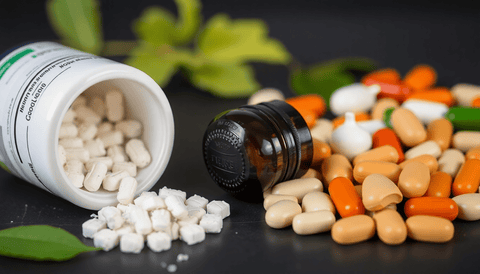
Most people think of supplements as small, harmless additions to a healthy lifestyle — yet the environmental impact of supplements is far larger than the size of a vitamin pill suggests. From energy-intensive manufacturing and global ingredient sourcing to plastic packaging and expired products thrown in household waste, the supplement industry leaves a measurable planetary footprint. In this article, we explain what that footprint consists of, which parts of your vitamin habit contribute most to it, how supplement brands differ in sustainability claims, and — most importantly — what practical steps you can take to reduce waste and emissions without compromising your health.
What Does “Environmental Impact of Supplements” Actually Mean?
The environmental impact of supplements refers to the combined effects that producing, packaging, transporting, consuming, and disposing of vitamins, minerals, and other supplements has on ecosystems, natural resources, and greenhouse gas emissions. It covers everything from cultivating or synthesizing raw ingredients to the plastic bottle that ends up in your recycling bin — or landfill.
Why Your Vitamin Habit Has a Planetary Footprint
A supplement is never just a pill. Behind every capsule sits a supply chain: raw material extraction or cultivation, chemical processing, formulation, packaging production, long-distance freight, retail distribution, and eventual disposal. Each stage consumes energy, water, and materials, and generates waste and emissions. And because supplements are typically consumed daily over months or years, even small per-unit impacts multiply quickly. A multivitamin taken daily for a year means 365 servings, several packaging units, and countless transport kilometres.
The scale of the industry amplifies this. With hundreds of millions of people worldwide taking supplements regularly, even minor inefficiencies — excess packaging, overproduction, short shelf life — translate into significant cumulative environmental burdens.
The Difference Between Natural, Synthetic, and Highly Processed Ingredients
A common assumption is that “natural” ingredients are automatically more sustainable, but the reality is nuanced. Some naturally derived ingredients require large amounts of plant material, land, water, or wild harvesting. Synthetic vitamins, produced through industrial chemical processes, may have high energy requirements but can also be highly efficient in terms of yield and land use. Highly processed or extracted ingredients — concentrated plant extracts, refined oils, isolated compounds — often involve multiple processing steps, solvents, and purification, each adding an environmental cost.
In short, neither “natural” nor “synthetic” is inherently greener. What matters is the efficiency of the process, the source of the raw material, and how responsibly it is harvested or produced.
How Are Supplements Manufactured, and What Does It Cost the Planet?
Resource Intensity of Raw Ingredient Extraction and Cultivation
Plant-derived ingredients such as herbal extracts, botanicals, and superfood powders require agricultural land, water, and often pesticides or fertilizers. Crops grown for supplements compete with food production for farmland. Wild-harvested ingredients raise additional concerns: overharvesting can deplete wild populations and damage ecosystems, especially for slow-growing plants or marine species.
Mineral and some vitamin raw materials involve mining or industrial extraction, which carries its own footprint — land disturbance, energy use, and waste byproducts. Marine-derived ingredients such as omega-3 fish oils depend on fish stocks, linking supplement production directly to ocean health.
Energy Use and Chemical Inputs in Processing and Synthesis
Turning raw materials into a finished supplement involves extraction, concentration, drying, milling, blending, and encapsulation or tableting. Many of these steps are energy-intensive, relying on heat, centrifugation, freeze-drying, or chemical synthesis. Solvent extraction is common for botanicals, and solvents must be recovered or disposed of safely. Synthetic vitamin production involves multi-step chemical reactions that require energy, catalysts, and reagents.
Quality control — testing for purity, potency, and contaminants — is essential but also consumes laboratory resources. Facilities with renewable energy and efficient processes can substantially reduce this footprint, which is one reason energy sourcing is a meaningful differentiator between manufacturers.
The Water Footprint of Production Facilities
Water is used throughout supplement production: cleaning equipment, generating steam, cooling, dissolving and blending ingredients, and producing liquids and softgels. Water consumption varies widely depending on the product type. Powdered supplements generally require less processing water than liquids; softgel and capsule production can be more water-intensive. Facilities in water-stressed regions or without water-recycling systems contribute more to local water depletion than those with closed-loop cleaning and treatment systems.
Packaging Waste: The Most Visible Environmental Problem
Packaging is often the single most visible part of a supplement's footprint, and for many consumers it is the easiest place to see waste. Supplement packaging typically combines plastic bottles, metal caps, tamper seals, desiccants, cotton stuffing, printed labels, and outer cartons — much of it single-use.
Why Multi-Ingredient Formulas Multiply Plastic Waste
A well-formulated multivitamin can actually reduce packaging compared with taking six separate single-nutrient products, because one bottle replaces half a dozen. Conversely, if your routine involves many separate products, each with its own bottle, cap, and carton, your packaging waste multiplies accordingly. Consolidating your routine is one of the simplest waste-reduction strategies available.
Glass vs. Plastic vs. Pouches: Comparing Packaging Footprints
Each packaging material involves trade-offs:
- Glass is widely recyclable and inert, but heavy — meaning higher transport emissions — and energy-intensive to produce.
- Plastic is lightweight and efficient to transport, but made from fossil fuels and frequently not recycled in practice, especially mixed or colored plastics.
- Flexible pouches and sachets use very little material, but multi-layer laminated pouches are rarely recyclable in standard systems.
- Metal tins are durable and highly recyclable, but energy-intensive to manufacture initially.
There is no universally “best” option; the most sustainable packaging is often the one that is actually recycled in your local waste system, used to its full capacity, and not over-produced.
What Happens to Expired or Unused Supplements
Expired or unused supplements frequently end up in household waste or, worse, flushed down the toilet — where active compounds can enter waterways and affect aquatic ecosystems. Most supplements should be returned to pharmacies or designated collection points for proper disposal where such schemes exist. Prevention matters even more: buying realistic quantities, checking expiry dates, and storing products correctly all reduce the amount that ends up as waste.
The Supply Chain: Where Do Supplement Ingredients Come From?
The Carbon Cost of Global Sourcing and Ocean Freight
Supplement supply chains are typically global. A single product may contain vitamin C synthesized in China, fish oil from South America, botanical extracts from India, and packaging from Europe. Raw materials often travel thousands of kilometres between farms, processing plants, and packaging facilities before reaching consumers. Sea freight is relatively efficient per tonne-kilometre, but the sheer distances involved mean transport contributes meaningfully to a product's carbon footprint — especially when ingredients cross multiple continents. Brands that consolidate sourcing or manufacture closer to their markets reduce this burden.
Environmental Concerns in Wild Harvesting and Overfishing
Marine-derived supplements deserve specific attention. Fish oil and krill oil production depends on wild fish stocks, and while responsible producers source from certified, well-managed fisheries, poorly regulated harvesting can contribute to overfishing and disrupt marine food webs — with consequences for species that depend on those same small fish, including penguins and whales. Plant-based wild harvesting raises similar concerns: demand for popular botanicals has contributed to overharvesting of some wild plant species in vulnerable regions. Certifications from recognized sustainability bodies, along with traceable sourcing, help distinguish responsible producers.
Palm Oil, Gelatin, and Other Hidden Ingredient Impacts
Some environmental impacts hide in excipients — the inactive ingredients that hold a supplement together. Gelatin, common in capsules and softgels, derives from animal agriculture, with associated land use and emissions. Palm oil derivatives appear in some formulations and carriers; palm cultivation is a major driver of deforestation in Southeast Asia when not responsibly sourced. Magnesium stearate, titanium dioxide alternatives, coatings, and carriers each carry their own sourcing story. Plant-based capsule shells (such as cellulose-based alternatives) and certified sustainable excipients offer lower-impact options.
How Your Supplement Choices Create More or Less Waste
Single Nutrients vs. Multivitamins: Which Is More Efficient?
From a packaging and logistics perspective, a single well-chosen multivitamin generally generates less waste than a cabinet full of individual products. However, the calculus depends on what you actually need: if you only require vitamin D in winter, one small, targeted product is more efficient — and less wasteful — than a comprehensive multivitamin containing nutrients you don't need. The most efficient routine is the smallest one that meets your genuine nutritional requirements.
Capsules, Tablets, Powders, and Liquids: A Waste Comparison
Delivery form matters more than most consumers realize:
- Powders typically have the lowest packaging-to-serving ratio, especially in larger formats, and avoid the resource cost of capsule shells.
- Tablets are compact and dense, requiring minimal packaging per dose, though coatings and binders add processing inputs.
- Capsules require gelatin or plant-based shells, adding an extra ingredient stream.
- Softgels combine an oil fill with a gelatin shell, generally carrying a higher per-dose footprint.
- Liquids demand heavier, more protective packaging and often preservatives, plus shorter shelf life.
Form should still be chosen primarily for absorption and personal tolerance — but where two forms work equally well for you, the lower-waste option is a reasonable tiebreaker.
The Problem with Individually Wrapped Doses
Single-serve sachets, blister packs, and daily dose strips maximize convenience but minimize material efficiency. Individually wrapped doses can multiply packaging several-fold compared with a single refillable container, and blister foil-plastic laminates are notoriously difficult to recycle. If daily-dose packaging is medically or practically necessary — for example, for travel or adherence — it can be justified; as a default format, it is usually the least sustainable choice.
Can Supplements Ever Be Carbon-Neutral or Regenerative?
What “Carbon-Neutral” Claims Do and Do Not Mean
“Carbon-neutral” supplement claims usually mean a company has calculated its emissions and purchased offsets to compensate. This does not necessarily mean the product itself produced no emissions — it means emissions were theoretically balanced elsewhere. Offset quality varies enormously, and critics rightly note that offsets don't reduce emissions at the source. A more meaningful indicator is whether a brand is actively reducing emissions in its own operations and supply chain, with offsets as a complement rather than a substitute.
Regenerative Farming as a Sourcing Model
Regenerative agriculture — farming practices that rebuild soil health, increase biodiversity, and can sequester carbon — is emerging in supplement sourcing, particularly for botanicals and superfood ingredients. Practices such as crop rotation, reduced tillage, cover cropping, and organic soil management can make plant-based ingredient cultivation a net positive for land health rather than merely less harmful. This remains a growing rather than dominant sourcing model, so it's worth asking brands specifically about how their botanical ingredients are grown.
Biodegradable Packaging and Refill Systems That Actually Work
Promising innovations include compostable pouches, refillable tins with refill bags, and packaging made from recycled ocean plastic or agricultural byproducts. The key question is whether these systems work in practice: a compostable pouch only helps if industrial composting is available where you live; a refill system only helps if you actually use it repeatedly. Packaging that reduces material use — or enables reuse — generally outperforms clever materials that end up in landfill anyway.
Practical Ways to Reduce the Environmental Impact of Your Supplement Routine
How to Choose Brands with Genuine Transparency
Look for brands that publish concrete information: where ingredients are sourced, what packaging is made from, whether facilities use renewable energy, and what certifications they hold. Genuine transparency includes specifics — percentages, sourcing regions, third-party verification — rather than vague statements like “eco-friendly” or “green.” Brands such as those emphasizing natural and traceable sourcing, for example in collections focused on natural supplements, make it easier to assess what you're actually buying.
Buying Larger Quantities and Consolidated Formulas to Reduce Packaging
Buying a 3- or 6-month supply in one container dramatically reduces packaging per dose compared with monthly purchases — provided you will genuinely use the product before expiry. Similarly, consolidating multiple single-nutrient products into one appropriate formula (where it fits your needs) reduces bottles, transport, and waste. The trade-off to manage is expiry: only buy in bulk what you will realistically consume.
Correct Disposal: What to Do with Old Vitamins
Do not flush supplements or pour liquids down the drain. Where pharmacy take-back schemes exist, return expired products there; otherwise, dispose of them in sealed household waste according to local guidance. Better yet, reduce expired waste at the source by keeping your routine lean, storing products in cool, dry places to preserve their shelf life, and checking your cabinet before reordering.
When Whole Foods and Diet Are the More Sustainable Choice
Diet should always come first — nutritionally and environmentally. For most people with a varied, balanced diet, many nutrients are adequately covered by food, and food generally delivers nutrients with a far lower packaging footprint per serving. Seasonal, local, minimally processed foods require no capsule shells, bottles, or global freight. Supplements earn their place when they address genuine gaps: vitamin D in low-sunlight months, vitamin B12 for those following plant-based diets, or specific needs identified through diet assessment or testing. If your diet covers a nutrient, the most sustainable supplement is the one you don't need to buy. For background on specific vitamins and their food sources, our guides to vitamin D and B vitamins explain where diet alone may or may not suffice.
How to Interpret Environmental and Sustainability Claims on Labels
Recognizing Greenwashing vs. Verified Certifications (e.g., B Corp, FSC, Leaping Bunny)
Greenwashing — marketing that implies environmental benefit without substance — is widespread. Warning signs include vague terms (“natural,” “eco,” “green”) with no evidence, a single green attribute overshadowing an otherwise opaque supply chain, and imagery of leaves or planets without certification. In contrast, verifiable marks — B Corp certification, FSC for paper packaging, recognized sustainability certifications for marine ingredients, cruelty-free certifications — involve independent auditing. Always check whether a logo is backed by an actual certifying body, not just invented in a design department.
Third-Party Audits and Life-Cycle Assessments: What to Look For
The most rigorous form of environmental evidence is a life-cycle assessment (LCA): a systematic analysis of a product's environmental impact from raw material to disposal. Brands that commission third-party LCAs or independent audits of their supply chains are operating at a level well beyond industry norms. At minimum, look for published sustainability reports with measurable targets, verified emissions data, and named certifications. The absence of any such documentation doesn't prove a product is unsustainable — but it gives you nothing to judge.
Do the Environmental Benefits of Taking Supplements Ever Outweigh the Costs?
Comparing the Footprint of Supplements Against Fortified Foods
In some cases, supplements can be the lower-impact route to a nutrient. Taking a small vitamin D capsule during winter, for example, has a far smaller footprint than frequently consuming fortified products shipped long distances or increasing intake of foods purely to hit a nutrient target. A concentrated supplement delivers a specific nutrient with minimal food mass, minimal calories, and minimal agricultural land per unit of nutrient — a genuine efficiency advantage when the need is real.
When Supplementation Reduces Food Waste or Supports Sustainable Diets
Supplements can also enable more sustainable eating patterns. Someone following a plant-based diet who takes vitamin B12 or an algae-based omega-3 avoids relying on animal products they would otherwise eat partly for nutritional reasons. Nutritional support can make sustainable dietary choices safer and more maintainable, which arguably amplifies their long-term environmental benefit. The key is that supplementation complements — rather than replaces — a thoughtful diet.
Key Questions to Ask Before Your Next Supplement Purchase
Is This Supplement Necessary for Me, or Is It Discretionary?
The most impactful question is also the simplest. A supplement addressing a documented gap — low sunlight exposure, a restrictive diet, increased needs during pregnancy or aging — justifies its footprint. A discretionary product taken “just in case” may not. Reviewing your routine honestly, and asking a healthcare professional or dietitian where you're unsure, is both a health and an environmental decision.
What Is the Company’s Track Record on Sustainability?
Look beyond the label. Does the company publish sourcing information? Hold recognized certifications? Report emissions or packaging targets? A short search of the brand's website and sustainability reports can reveal whether environmental claims are substantive or decorative.
Does the Product’s Delivery Form Suit My Needs Without Unnecessary Waste?
Match the form to the function. Powders and tablets generally carry less packaging overhead; softgels and liquids may be preferred for absorption or practical reasons. Individually wrapped doses are convenient but packaging-heavy. Choosing the simplest effective form avoids waste without sacrificing benefit.
The Bottom Line: Making an Informed, Lower-Impact Choice
Balancing Personal Health Needs with Environmental Responsibility
The goal is not to eliminate supplements — for many people they serve legitimate, sometimes essential nutritional purposes — but to eliminate the unnecessary ones and make necessary ones as low-impact as possible. The most effective levers, roughly in order of impact, are: taking fewer supplements (only what you genuinely need), choosing consolidated formulas and larger sizes to reduce packaging, favoring brands with verified sustainability practices, minimizing individually wrapped doses, and disposing of expired products correctly.
The Role of Professional Advice in Avoiding Unnecessary Supplement Use
A dietitian, doctor, or pharmacist can help you identify which supplements you actually need — often the single most effective way to shrink your supplement footprint. Testing where appropriate (for example, checking vitamin D status) can replace guesswork with evidence, ensuring that what you take is justified. Individual needs vary with diet, age, sun exposure, life stage, and health status, so a routine that is genuinely necessary for one person may be entirely discretionary for another. When in doubt, seek professional advice rather than defaulting to “take everything.”
Key Takeaways
- The environmental impact of supplements spans the full supply chain: ingredient sourcing, manufacturing energy and water use, global transport, packaging, and disposal.
- Neither “natural” nor “synthetic” ingredients are inherently more sustainable — process efficiency and responsible sourcing matter most.
- Packaging is the most visible footprint component; consolidating formulas and buying realistic quantities reduce it substantially.
- Marine-derived and wild-harvested ingredients can affect ecosystems when sourcing is unregulated; certified, traceable sourcing mitigates this.
- Individually wrapped doses and multi-product routines multiply packaging waste compared with powders, tablets, and consolidated formulas.
- “Carbon-neutral” claims often rely on offsets; emission reduction at the source and third-party certifications are stronger indicators.
- A varied diet covers many nutrient needs with a far lower packaging footprint; supplements are best reserved for genuine gaps.
- Expired supplements should never be flushed — use pharmacy take-back schemes or sealed household waste.
- The single biggest environmental win is taking only the supplements you actually need, ideally confirmed with professional advice.
Frequently Asked Questions
What is the environmental impact of supplements?
It refers to the combined effects of producing, packaging, transporting, and disposing of supplements — including energy and water use in manufacturing, agricultural or industrial sourcing, freight emissions, plastic packaging waste, and improper disposal of expired products. Because supplements are used daily over long periods, small per-unit impacts accumulate significantly.
Are natural supplements better for the environment than synthetic ones?
Not necessarily. Natural ingredients can require substantial land, water, and wild harvesting, while synthetic vitamins may be energy-intensive but land-efficient. Sustainability depends on how efficiently a specific ingredient is produced and sourced, not on whether it is labeled natural or synthetic.
Which supplement packaging is most eco-friendly?
There is no universal winner. Glass is recyclable but heavy; plastic is lightweight but fossil-based and often unrecycled; pouches use little material but are rarely recyclable. The best choice is usually the packaging with the least material that your local waste system can actually process — and refills or larger containers reduce impact further.
Do multivitamins create less waste than individual supplements?
Generally yes, because one bottle replaces several. However, if you only need one or two specific nutrients, targeted single products can be more efficient than a comprehensive multivitamin containing nutrients you don't require. Match the product to your genuine needs.
How should I dispose of expired vitamins?
Never flush them or pour them down the drain, as active compounds can enter waterways. Use pharmacy take-back or collection schemes where available; otherwise, dispose of them in sealed household waste according to local guidance. Buying realistic quantities helps prevent the problem in the first place.
Are fish oil supplements bad for the ocean?
Impact depends on sourcing. Fish oil from certified, well-managed fisheries has a manageable footprint, while poorly regulated harvesting can contribute to overfishing and disrupt marine food webs. Algae-based omega-3 offers a plant-based alternative with a lower direct impact on wild fish stocks.
What does “carbon-neutral supplement” actually mean?
It usually means a company has calculated the product's emissions and purchased offsets to compensate. This does not mean the product was emission-free — offset quality varies widely. Brands actively reducing their own emissions are generally making more meaningful efforts than those relying solely on offsets.
Can taking supplements actually be better for the environment than food sources?
Sometimes. A concentrated supplement can deliver a nutrient with minimal land, food mass, and packaging compared with increasing intake of whole or fortified foods — particularly for nutrients like vitamin D in winter or B12 on plant-based diets. The advantage applies when the supplement addresses a genuine need.
How can I spot greenwashing in supplement marketing?
Be skeptical of vague terms like “eco-friendly” or “green” without evidence, nature imagery without certification, and single environmental attributes used to distract from an opaque supply chain. Genuine sustainability is backed by named certifications, published sourcing details, and measurable targets.
Do plant-based capsules have a lower environmental impact than gelatin capsules?
Plant-based capsule shells avoid the footprint of animal agriculture associated with gelatin, but they still require cultivated raw materials and industrial processing. The difference is generally modest compared with bigger levers like packaging and number of products in your routine.
Is it more sustainable to buy supplements in bulk?
Yes, provided you will use them before expiry. Larger containers reduce packaging per serving and fewer orders mean less transport. Buying bulk products you ultimately discard negates the benefit, so match quantities to realistic consumption.
Do supplements expire and lose potency?
Yes. Vitamins and other supplements degrade over time, especially when exposed to heat, light, and moisture. Checking expiry dates, storing products in cool, dry places, and rotating your stock reduces both potency loss and waste.
Related Keywords
- environmental impact of supplements
- sustainable supplement packaging
- eco-friendly vitamins
- carbon footprint of vitamins
- supplement packaging waste
- greenwashing supplement brands
- are supplements bad for the environment
- how to dispose of expired vitamins
- plastic-free supplement packaging
- regenerative farming supplements
- fish oil sustainability and overfishing
- carbon-neutral supplement claims
- plant-based vs gelatin capsules environment
- sustainable vitamin brands