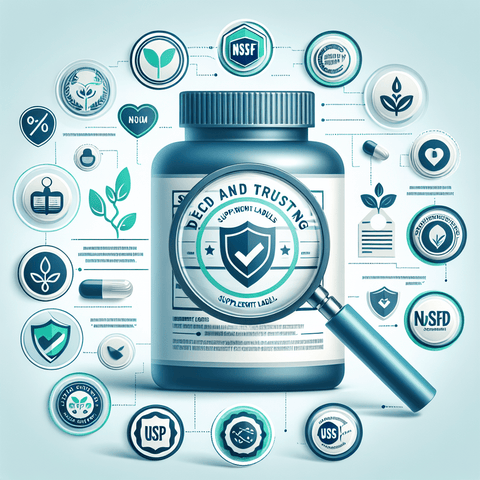
Supplement label decoding is the skill of turning a crowded product label into clear, usable information: what the product actually contains, how much of each nutrient it provides, in which chemical form, and whether that dose fits safe, sensible use. This article explains how to read the nutrient panel and ingredient list, what percentage values really mean, why units and nutrient forms matter for absorption, and which warnings and quality indicators deserve a closer look. Whether you compare multivitamins, minerals, or single-ingredient products, these skills let you evaluate any label objectively — before packaging, price, or marketing claims influence the decision.
What Supplement Label Decoding Actually Means
Supplement labels contain two very different types of information. The first is regulated by law: the nutrient content per serving, the serving size, the full ingredient list, allergen declarations, and the responsible manufacturer or distributor. The second is marketing: phrases such as "advanced formula" or "high potency" that often have no legal definition. Supplement label decoding is largely the practice of separating the two — focusing on standardized facts you can compare, and treating promotional language with healthy skepticism. In the European Union, supplements are legally classified as foods, so labels must state each added vitamin and mineral with its amount per serving; in the United States, the Supplement Facts panel serves the same function.
The Label, Section by Section
Serving Size and Servings per Container
Everything on a supplement label is expressed relative to the stated serving size — the doses, the percentage values, and effectively the price per day. A container that looks affordable may become considerably more expensive once you notice the recommended serving is three capsules taken twice daily. Equally important is checking whether one serving equals one day's intake. If a label lists 500 mg of a nutrient per capsule and the serving is four capsules, the daily total is 2,000 mg — a figure that should always be checked against safe upper limits rather than assumed to be reasonable.
Nutrients, Amounts, and Percentage Values
The heart of the label is the nutrient table: each vitamin and mineral, its amount per serving, and a percentage figure. In the US this is the % Daily Value (DV); in the EU it is the % Nutrient Reference Value (NRV). These percentages describe the reference intake for an average healthy adult — not your personal requirement, which varies with age, sex, diet, pregnancy, and health status. Two practical points follow. First, 100% is a benchmark for avoiding deficiency, not a proven optimum. Second, several meaningful ingredients — omega-3 fatty acids, probiotics, and most plant extracts — have no established reference value, so a missing percentage does not mean an ingredient is unimportant.
The Ingredient List and "Other Ingredients"
Below the nutrient table sits the full ingredient list, generally ordered by descending weight: the most abundant component first. This is where you find the chemical form of each nutrient, the capsule or tablet material, and everything else the product contains. Terms such as fillers, anti-caking agents, and coatings sound alarming but are usually functional — they keep powders from clumping and tablets from sticking to machinery. They become genuinely relevant if you have allergies or dietary preferences: gelatin versus vegan capsule shells, soy-derived ingredients, or allergens that must be declared on the label. Reading this section takes seconds and answers questions the marketing text never will.
Understanding Doses, Units, and Upper Limits
Units are a common source of confusion. Nutrients appear in milligrams (mg), micrograms (mcg or µg), and occasionally international units (IU), an older measure of biological activity still used for vitamins A, D, and E. The critical distinction is between mg and mcg: one milligram equals one thousand micrograms, so mistaking 100 mcg for 100 mg overstates the dose a thousandfold. Conversions matter when comparing products — 400 IU of vitamin D corresponds to 10 mcg, and many labels now state both. Some minerals are also listed as whole compounds rather than elemental amounts, so the labeled weight may not equal the amount of active mineral your body receives.
Doses also have a safety ceiling. Health authorities such as the European Food Safety Authority (EFSA) and the US National Academies publish Tolerable Upper Intake Levels (ULs): the maximum daily amount considered unlikely to cause harm over time. For adults, the UL for vitamin D is 100 mcg (4,000 IU) per day in both Europe and the US, while zinc and selenium have upper limits in the low tens of milligrams and a few hundred micrograms respectively. Long-term intake above these levels is where risk accumulates, particularly for fat-soluble vitamins and minerals such as iron, which the body cannot easily excrete.
Finally, distinguish reference values from research doses. The %NRV reflects the intake needed to prevent deficiency in most healthy adults, whereas studies of specific health outcomes sometimes use different amounts. A label boasting 2,000% of the daily reference value is not twenty times better — for many nutrients, absorption efficiency declines as dose rises, and surplus water-soluble vitamins are simply excreted.
Why the Chemical Form of a Nutrient Matters
The same nutrient can appear as several different compounds, and the form influences absorption, elemental content, and tolerability. Magnesium oxide is inexpensive but comparatively poorly absorbed, while magnesium citrate and magnesium bisglycinate are absorbed more efficiently and are often gentler on digestion. Calcium carbonate contains a high proportion of elemental calcium but depends on stomach acid and is best taken with food, whereas calcium citrate is less dependent on acid. Vitamin D3 generally maintains blood levels somewhat better than vitamin D2, and iron bisglycinate is often better tolerated than ferrous sulfate. These differences are worth checking — but so are their limits.
The differences between forms are usually a matter of degree rather than night and day, and head-to-head evidence is limited for many of them. Total dose, consistency of use, and digestive tolerability typically matter more than chasing a single "best" form. Before assuming that a familiar compound name is automatically the better choice, it helps to consult ingredient-specific guidance, such as an overview of different magnesium forms or detailed mineral supplement guidance covering iron, zinc, and selenium.
Marketing Claims and Common Red Flags
Certain label features should slow you down. A proprietary blend lists several ingredients under one name with only a total weight, hiding how much of each component the product contains — making it impossible to verify whether doses match those used in research. This format is common on US labels, while EU rules generally require amounts for each added nutrient. Undefined quality terms such as "pharmaceutical grade" or "clinically proven" also deserve scrutiny, especially when the cited studies tested different doses or forms than the product delivers. Combining products is another hidden risk: a multivitamin plus a high-dose single nutrient can quietly push total intake above safe levels, which is why reviewing multivitamin ingredients and usage guidance is worthwhile before stacking products.
Safety Information Worth Reading Twice
The warning section is not legal boilerplate; it often contains the most safety-relevant text on the label. Standard statements such as "do not exceed the recommended dose" and "keep out of reach of children" matter most for products containing iron, a common cause of accidental poisoning in young children. Labels frequently advise caution during pregnancy and breastfeeding, and some interactions are specific: vitamin K can reduce the effect of anticoagulant medicines such as warfarin, which is why people on blood thinners are advised to keep vitamin K intake stable and consult their prescriber. Allergen declarations, expiry dates, and storage instructions complete the safety picture.
Quality Signals Beyond the Nutrients
A label can also reveal how seriously a manufacturer treats quality. Third-party testing seals — such as USP, NSF, or Informed Sport — indicate that an independent laboratory has verified ingredient identity, potency, and the absence of specified contaminants like heavy metals. Good Manufacturing Practice (GMP) certification, batch numbers, and a clearly named responsible company are further positive markers. The absence of a seal does not automatically mean poor quality, but credible independent verification adds confidence that what the label states is what the capsule delivers — something no marketing claim can substitute for.
Food First: What a Label Cannot Tell You
Label reading tells you what is in a product, not what your body needs. For most healthy adults, a varied diet — vegetables, fruit, whole grains, legumes, fish or alternative omega-3 sources, and adequate protein — covers the majority of nutrient requirements, and many countries fortify staple foods such as flour, salt, or plant-based milks. Shortfalls become more plausible with restrictive diets, limited sun exposure relevant to vitamin D intake and safety, pregnancy, older age, or medical conditions and medications that impair absorption. In these situations, a blood test or professional assessment is usually far more informative than guessing from symptoms, and any supplement decision should follow from that evaluation rather than replace it.
A Practical Framework for Evaluating Any Product
Once the basics are familiar, supplement label decoding becomes a repeatable checklist you can apply in minutes:
- Start with the serving size. Confirm how many capsules or scoops form one daily serving, and what that costs per day.
- Check the nutrients you actually want. Note the amount per serving and the chemical form — not just the nutrient name.
- Read percentages critically. Use %NRV or %DV for comparison, and treat very high percentages as a prompt to check upper intake levels.
- Scan the full ingredient list. Look for allergens, gelatin versus vegan capsules, and added ingredients you may not want.
- Read every warning. Pregnancy, medication use, and age restrictions apply to some readers only — but are critical for them.
- Check quality markers. Third-party testing, batch numbers, and a named responsible manufacturer add credibility.
- Do the math across products. Add up totals from all supplements you take to avoid unintentional excess.
Key Takeaways
- The regulated parts of a supplement label are the nutrient amounts, serving size, ingredient list, and allergen declarations; most other phrases are marketing.
- All doses are per serving — check servings per container and whether one serving equals one day's intake.
- % Daily Value and % NRV describe reference intakes for average adults, not personal requirements or optimums.
- Never confuse mg with mcg; a thousandfold difference separates them, and conversions such as 400 IU vitamin D = 10 mcg matter when comparing products.
- The chemical form of a nutrient, such as magnesium oxide versus bisglycinate, affects absorption and tolerability, though differences are often modest.
- Tolerable Upper Intake Levels define long-term daily ceilings; fat-soluble vitamins and minerals like iron, zinc, and selenium deserve particular attention.
- Proprietary blends hide individual ingredient doses and make evidence-based evaluation difficult.
- Third-party testing seals and batch numbers are among the most trustworthy quality signals on a label.
- Labels show product content, not personal need — diet, testing, and professional advice should guide whether a supplement is necessary at all.
Frequently Asked Questions
What is the difference between the nutrient panel and the ingredient list?
The nutrient panel lists the active vitamins and minerals with their amounts per serving and percentage values. The ingredient list shows every component in descending order by weight, including the chemical form of each nutrient, capsule materials, fillers, and allergens. You need both: the panel tells you how much, while the list tells you in what form and what else is inside.
What does % Daily Value or % NRV actually mean?
It expresses the amount of a nutrient in one serving as a percentage of the reference intake for an average healthy adult. It serves as a benchmark for comparing products and avoiding deficiency, not as a personalized target. Individual needs can be higher or lower depending on age, sex, diet, pregnancy, and health status.
Why do some supplement labels use IU instead of mg or mcg?
International units (IU) measure biological activity rather than weight and are a legacy unit still used for vitamins A, D, and E. Many labels now add the weight equivalent, such as 10 mcg (400 IU) for vitamin D. When comparing products, convert to the same unit first, because IU values cannot be directly compared with milligram values.
What is a proprietary blend and why is it a problem?
A proprietary blend lists several ingredients under one name with only the total weight, without stating how much of each ingredient is present. This makes it impossible to check whether doses match the amounts used in research. EU labels generally require amounts for each added nutrient, while the blend format is common on US products.
What are "other ingredients" on a label?
These are non-nutrient components such as capsule shells, fillers, anti-caking agents, coatings, and flavorings that keep the product stable and manufacturable. Most are functional and used in very small amounts, but they matter if you have allergies, intolerances, or preferences such as avoiding gelatin. Major allergens must be declared on the label.
Which nutrient forms are better absorbed?
It depends on the nutrient: magnesium citrate and bisglycinate are generally better absorbed than oxide, calcium citrate is less dependent on stomach acid than carbonate, and vitamin D3 is somewhat more effective at raising blood levels than D2. Differences are usually moderate rather than dramatic, and research comparing forms is limited for many nutrients. Tolerability and total dose often matter as much as the form itself.
How can I tell if a supplement is third-party tested?
Look for a recognized seal such as USP, NSF, or Informed Sport, or a statement that the product is independently verified, ideally with a certificate of analysis available on request. These programs confirm that the product contains what the label states and is free from specified contaminants. A missing seal does not prove poor quality, but a credible seal provides independent assurance.
Which label warnings should I take most seriously?
Warnings about pregnancy, breastfeeding, medication interactions, and age restrictions are the most individually significant — for example, vitamin K products advise caution for people taking anticoagulants such as warfarin. "Do not exceed the recommended dose" and "keep out of reach of children" are especially important for iron-containing products. If any warning applies to you, discuss the product with a qualified healthcare professional first.
Can you take too much of a vitamin or mineral?
Yes, particularly with fat-soluble vitamins A, D, and E and minerals such as iron, zinc, and selenium, which the body stores or excretes slowly. Risk comes mainly from habitual intake above the Tolerable Upper Intake Level, often accumulated across multiple products. Adding up the totals from every supplement you take is the simplest way to check.
Does the expiration date really matter?
Yes. Manufacturers guarantee the labeled nutrient amounts only until the expiry date, assuming proper storage, because vitamins and other compounds gradually lose potency. Heat, light, and humidity accelerate this process, which is why storage instructions matter. A product used well past expiry may still be safe but can deliver less than the stated dose.
Related Keywords
- supplement label decoding
- how to read a supplement label
- supplement facts panel
- percent daily value meaning
- nutrient reference value
- proprietary blend
- ingredient list order
- nutrient bioavailability and forms
- tolerable upper intake level
- supplement dosage per serving
- third-party tested supplements
- supplement safety warnings
- active and other ingredients
- supplement quality indicators
- megadosing risks