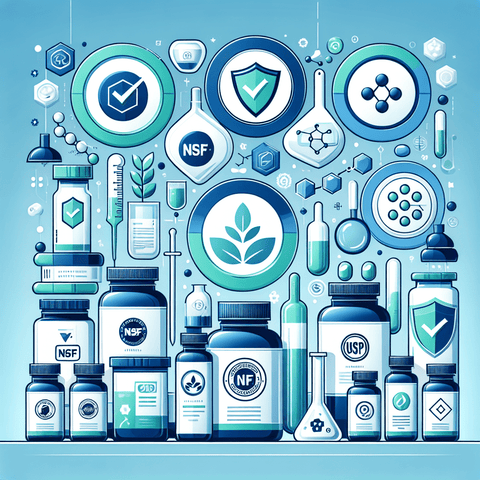
Supplement purity certifications are independent, third-party verification programs that test dietary supplements for identity, potency, and contaminants such as heavy metals, pesticides, and undeclared allergens. Because supplements are not FDA-reviewed or approved before they reach the market, these certification marks — including NSF/ANSI 173, USP Verified, Informed Sport, and BSCG — are among the most reliable quality signals available to shoppers. This guide explains what supplement purity certifications actually verify, how they differ from marketing terms like "pharmaceutical grade," which label red flags suggest an unverified product, and how to use certification databases and certificates of analysis to choose supplements that are clean, accurately labeled, and appropriate for your needs.
Introduction: Why Supplement Purity Certifications Matter Before You Buy
Walk down any supplement aisle — physical or online — and you will find hundreds of products with confident, professional-looking labels. What the packaging rarely shows is how differently the products behind those labels can be made. Two bottles of the same vitamin may come from facilities with very different standards, raw materials of very different quality, and very different levels of testing.
Unlike prescription medicines, dietary supplements do not undergo FDA review for safety or effectiveness before they are sold. Manufacturers are legally responsible for their own products' quality, which means part of the burden of separating well-made supplements from poorly made ones falls on the buyer. Supplement purity certifications exist to close that gap: independent organizations test products against published standards and license their marks only to those that pass. Understanding how these programs work — and what they do not guarantee — is one of the most useful skills you can bring to choosing vitamins, minerals, herbal products, or a multivitamin.
What Are Supplement Purity Certifications? Key Terms Explained
What "purity" means for a supplement: identity, potency, and contaminants
In quality-control language, "purity" for a supplement is really three separate claims:
- Identity — the product contains what the label says it contains: the right vitamin or mineral, the correct chemical form, and for herbal products, the right plant species.
- Potency — the amount of each active ingredient matches the label claim, both at manufacture and at the end of the product's shelf life.
- Cleanliness — the product is free from harmful levels of contaminants such as heavy metals, pesticide residues, solvent traces, microbes, undeclared allergens, and undeclared drugs.
A supplement purity certification is an external check on all three. Instead of relying on a brand's own claims, you rely on an independent body whose standards and methods are published and whose reputation depends on the products it approves.
Third-party testing vs. GMP vs. FDA regulation: what each term really means
These three terms are often mixed together, but they describe different layers of oversight. FDA regulation exists but is largely reactive: in the United States, supplements are regulated as a food subcategory under the 1994 Dietary Supplement Health and Education Act, and the agency generally takes action only after problems reach consumers.
GMP (Good Manufacturing Practices) are the legally required production rules for supplement makers — documented procedures covering identity, purity, strength, and composition. GMP compliance is an important baseline, but it is a statement about how a facility operates, not independent proof about the finished bottle in your hands.
Third-party testing means an independent laboratory analyzed the product — possibly once, on one batch. Certification goes further: it combines recurring product testing, facility audits, and the right to display a verifiable mark. Certification is the stronger, more continuous signal, and it is the focus of the rest of this article.
Why Supplement Purity Matters for Your Health and Safety
Heavy metals, banned substances, and undeclared allergens: what purity testing screens for
Independent purity testing looks for problems you cannot see, taste, or predict:
- Heavy metals. Lead, cadmium, mercury, and arsenic can contaminate mineral supplements, some botanicals, and products derived from seaweed or soil-grown plants. These elements accumulate in the body over time, so they matter most for products taken daily for months or years.
- Banned or undeclared substances. Stimulants, anabolic agents, and even prescription drugs have repeatedly been detected in products marketed for weight loss, bodybuilding, and sexual enhancement.
- Undeclared allergens. Traces of milk, soy, wheat, or egg that never appear on the label are serious concerns for people with allergies or celiac disease.
- Microbial contamination. Bacteria such as Salmonella occasionally appear in botanical powders and products using minimally processed plant material.
- Label inaccuracies. Independent testing frequently finds products containing less — or occasionally far more — of an active ingredient than stated, which affects both effectiveness and the risk of exceeding established upper intake levels.
Red Flags: Warning Signs a Supplement Isn't Purity-Verified
Label red flags: proprietary blends, miracle claims, and missing manufacturer details
A label often reveals a brand's quality intent before you verify anything else. Watch for:
- Proprietary blends that list ingredient names but hide individual amounts, making it impossible to compare doses against those used in research.
- Disease claims such as "cures," "treats," or "reverses" — supplement labels are not legally permitted to claim they treat diseases, so their presence signals a brand that ignores the rules.
- Missing manufacturer details, such as no company name, address, or contact information.
- No lot number or expiration date, which makes traceability and recalls impossible.
- Vague quality language such as "pharmaceutical grade" or "lab tested" with no certificate you can actually inspect.
A single red flag is a caution. Several together are good reason to keep shopping.
Why Quality Problems Happen: Causes and Risk Factors for Impure Supplements
The oversight gap: why supplements aren't FDA-approved before sale
Most impurity problems are not deliberate fraud. Global supply chains mean a single capsule may contain ingredients grown, extracted, and processed in several countries, and contamination can enter at the raw-material stage. Testing incoming materials and finished batches costs money, and smaller or less careful companies may skip steps. Because the FDA's role is largely post-market, problem products are often identified only after consumers have already bought them. Historically higher-risk categories include weight-management, sports performance, sexual enhancement, and some imported herbal products. None of this means most supplements are unsafe — but it explains why independent verification adds real value.
How Much Verification Do You Need? Why the Answer Is Personal
The right level of verification depends on your personal stakes. A competitive athlete subject to anti-doping regulations has essentially zero tolerance for banned-substance contamination, making batch-tested certification programs close to mandatory. Someone who is pregnant or breastfeeding, giving supplements to children, or managing kidney or liver disease has stronger-than-average reasons to prioritize purity, because developing bodies and impaired organs handle contaminants less effectively. A healthy adult choosing a basic product from a transparent brand may be comfortable with lighter verification, such as a published certificate of analysis. Budget matters too: certification adds cost, and it is legitimate to weigh that against the product category, how long you plan to take it, and your own risk tolerance.
Food First: Diet and Lifestyle Habits That Reduce Your Supplement Risk
The simplest way to lower supplement-related risk is to need fewer supplements. For most nutrients, a varied, mostly whole-food diet — vegetables, fruit, legumes, whole grains, nuts and seeds, oily fish, and dairy or fortified alternatives — covers the needs of most healthy adults, and food delivers nutrients alongside fiber and cofactors that influence absorption. Practical habits include:
- Eating oily fish once or twice weekly for omega-3 fats
- Including magnesium-rich foods such as legumes, nuts, whole grains, and leafy greens
- Getting sensible sun exposure for vitamin D, supported by diet in darker months — our vitamin D guide covers sources, testing, and safety in detail
- Using fortified foods strategically if you follow a vegan or heavily restricted diet
Where a genuine gap remains — vitamin B12 for vegans, for example — a single, well-verified supplement is simpler and lower-risk than a shelf of products with overlapping doses.
The Major Supplement Purity Certifications, Explained
Several independent programs dominate supplement quality verification. They differ in focus, but all operate against published standards and stake their own reputations on the products they approve.
NSF/ANSI 173 and NSF Certified for Sport: contaminant and banned-substance screening
NSF/ANSI 173 is an American National Standard written specifically for dietary supplements. Products certified to it are tested for identity, contaminants, and label accuracy, and their manufacturing facilities undergo recurring audits. NSF Certified for Sport builds on that foundation by adding screening for substances banned by major sports organizations, which is why it is widely relied on across professional and collegiate athletics.
USP Verified: what the mark confirms about identity, potency, and manufacturing
USP Verified confirms that a product contains the ingredients and amounts listed on its label, is free from harmful contaminant levels, and was manufactured using sound practices — verified through facility audits and periodic testing of products purchased on the open market. USP also publishes the quality standards many manufacturers reference; the verification mark indicates the finished product itself was independently assessed.
Informed Choice, Informed Sport, and BSCG: banned-substance testing programs
Informed Choice and Informed Sport, operated by the accredited laboratory network LGC, combine a pre-market review of a product's formulation and manufacturing risk with testing of every batch for banned substances before release. BSCG (Banned Substances Control Group) offers certification tiers that screen for banned drugs and, at higher tiers, a broader range of pharmaceutical contaminants. These programs are designed with athletes in mind, but any consumer benefits from the same batch-level scrutiny.
Organic, non-GMO, gluten-free, and vegan seals: what they do and don't verify
Organic, non-GMO, gluten-free, and vegan seals verify production attributes — farming practices, animal-derived ingredients, allergen handling — rather than overall purity or label accuracy. A certified organic botanical, for instance, restricts certain pesticides but can still contain naturally occurring heavy metals. Treat these seals as useful filters for ethical, religious, or allergy-related needs, not as substitutes for purity certification. ConsumerLab works differently: it purchases supplements independently, tests them, and publishes results, with passing brands able to license its mark. It functions as verification even though it is not a traditional certification program.
When Supplementation May Be Worth Considering (and When Food Is Enough)
General nutritional support vs. addressing a diagnosed deficiency
Supplements are tools for specific situations, not general insurance. Research suggests they add the most value when diet, physiology, or life stage leaves a measurable shortfall — pregnancy, older age, restricted diets, malabsorption conditions, or limited sun exposure, for example. A general "top-up" product may be reasonable for someone with an inconsistent diet, though it works best alongside food-based improvement rather than instead of it. Addressing a diagnosed deficiency is different: it typically calls for specific doses, a defined duration, and follow-up testing guided by a professional. The distinction matters for quality too — the higher the dose and the longer the use, the more an accurately labeled, contaminant-free product matters.
How to Choose a High-Quality, Certified Supplement
Verification first: recognized marks, certifier databases, and published results
Start with the mark, then verify it. NSF, USP, Informed Sport, and BSCG all maintain searchable public databases of certified products — check that the specific product name appears, since counterfeit marks occasionally surface on labels. If a brand promotes "third-party testing" without certification, ask for a lot-specific certificate of analysis from an ISO 17025-accredited laboratory. A brand that provides this readily is demonstrating transparency; one that dodges the request is telling you something too.
Nutrient form and bioavailability: why the chemical form matters
Nutrients differ meaningfully by chemical form. Magnesium oxide is inexpensive but poorly absorbed, while citrate and glycinate forms are better absorbed and often gentler on digestion. Vitamin D3 raises and maintains blood levels more effectively than D2. Calcium carbonate needs stomach acid and food for best absorption, whereas citrate suits older adults or people taking acid-suppressing medication. Form affects absorption and tolerability more reliably than it affects long-term health outcomes — evidence there is often limited. Our guide to mineral supplements compares common forms of iron, zinc, magnesium, and selenium.
Single-ingredient vs. combination formulas: transparency trade-offs
Single-ingredient products make dosing transparent and easy to adjust, which helps when you need a specific amount or want to avoid duplicating nutrients across products. Combination formulas are convenient but require scrutiny: check whether each component is dosed at a meaningful level or present in trace amounts for label appeal. Proprietary blends are the weakest option, because they conceal exactly the information a careful buyer needs.
Added ingredients, allergens, and delivery formats
Scan the "other ingredients" list for allergens, colors, sweeteners, and fillers. Delivery format affects practicality: tablets are compact and stable, capsules dissolve reliably, powders allow flexible dosing but require measuring, and liquids suit people who cannot swallow capsules but may need refrigeration. Some nutrients degrade with heat, light, or moisture, so storage instructions are part of quality assurance rather than decoration.
How to Read a Supplement Label for Purity and Quality Signals
The Supplement Facts panel: serving sizes, doses, and % Daily Value
Check the serving size first, since some products require two or three capsules to reach the dose listed. Compare the amount per serving against the Percent Daily Value to see whether the product delivers a meaningful nutritional dose or a token amount. Then review the nutrient forms used and the "other ingredients" list for allergens and additives. Finally, confirm the label names a manufacturer or distributor with contact details.
Certificates of analysis (CoA): what they show and how to request one
A certificate of analysis documents laboratory testing for one production lot: product name, lot number, test date, tests performed — typically identity, potency, heavy metals, and microbiology — results against specification, and the testing laboratory's details. Many transparent brands publish CoAs on their websites or supply them on request. When you receive one, confirm the lot number matches your bottle; a CoA for a different lot tells you little about the product in your hands.
"Pharmaceutical grade," "standardized," and other terms that aren't certifications
"Pharmaceutical grade," "clinical strength," "pure," and "premium" have no regulated definition for dietary supplements and cannot be verified from a label. "Standardized" is a legitimate manufacturing specification for herbal extracts — it means the extract contains a defined amount of a marker compound — but it describes consistency, not purity certification. The reliable test is always the same: is there an independent mark you can verify in a database, or documentation you can inspect?
Who May Benefit Most From Certified, Third-Party-Tested Supplements
Verification matters most for people with the least tolerance for error. Competitive athletes risk sanctions from contaminated products. Pregnant and breastfeeding women pass everything they consume to a developing baby. Children are more sensitive to contaminants per kilogram of body weight. People with kidney or liver disease clear contaminants less effectively, and immunocompromised individuals face higher stakes from microbial contamination. Anyone taking supplements daily for years also accumulates exposure over time. Product category matters as well: botanical products carry historically higher adulteration risk than single-nutrient products, so anyone choosing herbal supplements has extra reason to prioritize certification and published test results.
Safety Beyond the Seal: Interactions, Side Effects, and Professional Advice
What a purity certification does not guarantee
A purity certification confirms that a product was made properly and tested independently. It does not confirm that you need the product, that the dose suits your circumstances, or that it is free of side effects. Certified products can still interact with medications, exceed sensible intakes when combined with other supplements, or be inappropriate for specific conditions. Fat-soluble vitamins (A, D, E, and K) and minerals such as iron, selenium, and zinc have established upper intake levels, and more is not better. Treat certification as a quality gate — not a recommendation.
When to talk to a healthcare professional first
Speak with a doctor, pharmacist, or registered dietitian before supplementing if you take prescription medication — vitamin K can reduce warfarin's effect, calcium and magnesium interfere with absorption of some thyroid medicines, and long-term use of metformin or acid suppressants has been associated with lower vitamin B12 status. Professional advice is also warranted during pregnancy and breastfeeding, with kidney disease, and whenever high-dose iron or fat-soluble vitamins are under consideration. For iron in particular, a ferritin blood test is a far better starting point than symptom-based guessing, since excess iron carries real risks.
From Research to Purchase: Your Supplement Verification Checklist
Step 1: Clarify whether you need a supplement at all
Start with your diet. Could more oily fish, legumes, leafy greens, nuts, or fortified foods plausibly close the gap? Are you in a group with increased needs — pregnant, older, vegan, highly active, or taking medications that affect absorption? For nutrients with validated tests, such as vitamin D, vitamin B12, and iron, a blood test usually provides more useful information than any symptom checklist. If the need is genuinely uncertain, professional assessment beats product research.
Step 2: Verify the certification and testing claims independently
Look for a recognized certification mark, then confirm the product in the certifier's public database. If there is no mark, request a lot-matched certificate of analysis from an accredited laboratory. Confirm the label lists a manufacturer or distributor with contact details, a lot number, and an expiration date.
Step 3: Compare dose, form, and added ingredients across products
Compare your shortlist on dose per serving, nutrient form, Percent Daily Value, added ingredients, allergens, and price per effective dose. Favor labels that disclose every ingredient amount over proprietary blends. Once you choose, store the product as directed and note the expiry date.
Supplement purity certifications cannot tell you whether you need a supplement — that depends on your diet, life stage, health status, and medications. What they do is ensure the product you choose is what it claims to be: accurately labeled, dose-accurate, and free from harmful contaminant levels. Combine that verification with a food-first approach, testing where it is available, and professional guidance when medications or health conditions are involved, and supplement shopping becomes a far more predictable, lower-risk decision.
Key Takeaways
- Dietary supplements are not FDA-approved before sale, so independent third-party verification is the most reliable external quality check available.
- "Purity" covers three claims: identity (the right ingredient), potency (a label-accurate dose), and cleanliness (no harmful contaminant levels).
- The major certification programs are NSF/ANSI 173, NSF Certified for Sport, USP Verified, Informed Choice/Informed Sport, and BSCG.
- "Third-party tested" can mean a single lab test; certification involves recurring testing and facility audits — the stronger, more verifiable signal.
- Verify certification marks in the certifier's database and request lot-matched certificates of analysis for products without a seal.
- Organic, vegan, gluten-free, and non-GMO seals verify production attributes, not overall purity or label accuracy.
- Red flags include proprietary blends, disease-cure claims, missing manufacturer details, and unverifiable marketing terms.
- Verification needs are personal: athletes, pregnant women, children, and people with kidney or liver disease have the strongest reasons to insist on certified products.
- Certification confirms quality, not necessity or efficacy — dose, interactions, and professional advice still determine whether a supplement makes sense for you.
Frequently Asked Questions About Supplement Purity Certifications
Is "third-party tested" the same as "certified"?
No. Third-party tested means an independent laboratory analyzed the product at least once, often on a single batch. Certification means an independent body continuously audits the manufacturer and re-tests products against a published standard before authorizing use of its mark. Certification carries ongoing obligations and is generally the stronger signal.
Which is better: NSF or USP certification?
Both are reputable programs that verify label accuracy and contaminant levels. NSF offers a sport-specific tier — NSF Certified for Sport — that adds banned-substance screening, which USP does not. For everyday products, either mark indicates meaningful independent verification; for athletes, a sports-certification program is the more relevant choice.
Do certification programs test every batch?
It varies by program. Informed Choice and Informed Sport test every production batch before release. NSF and USP rely on a combination of facility audits, recurring product sampling, and testing of items purchased from retail shelves. Batch-tested programs offer the tightest link between a test result and the bottle you buy.
Does certification guarantee a supplement will work for me?
No. Certification confirms identity, potency, and purity — that the product is what it claims to be. It cannot tell you whether you need the nutrient, whether the dose suits you, or whether it will interact with your medications. Those questions depend on your diet, health status, and individual circumstances.
Are certified supplements worth the extra cost?
Certification costs money, and certified products often cost somewhat more. For products taken daily over long periods, given to children, used during pregnancy, or relied on by athletes, the added verification usually justifies a modest price difference. For occasional, low-dose use from a transparent brand with published test results, lighter verification may be a reasonable trade-off.
How can I check whether a certification mark is genuine?
Search for the exact product name in the certifier's public database — NSF, USP, Informed Sport, and BSCG all maintain searchable lists. If a product displaying a mark cannot be found in the certifier's database, treat the mark as decoration and choose a different product.
What is a certificate of analysis, and how do I get one?
A CoA is a laboratory document showing identity, potency, and contaminant test results for one production lot, along with the testing laboratory's details and accreditation. Transparent brands publish CoAs on their websites or provide them by email on request. Always match the lot number on the certificate to the lot printed on your bottle.
What does "pharmaceutical grade" actually mean on a supplement?
Nothing standardized. The term has no regulatory definition for dietary supplements in the United States and cannot be verified from a label. Some brands use it to imply exceptional purity, but only independent testing or certification can demonstrate quality.
Which supplement categories carry the highest contamination risk?
Historically, products marketed for weight loss, bodybuilding, and sexual enhancement show the highest rates of undeclared pharmaceutical ingredients, and some imported botanicals carry elevated heavy-metal risk. These categories benefit most from third-party certification or batch testing before purchase.
Does an organic or vegan seal mean a supplement is pure?
No. These seals verify how ingredients were produced or processed — farming standards, animal-derived ingredients, allergen handling — not whether the finished product is free from heavy metals or accurately dosed. Use them for personal and dietary requirements, and rely on purity certifications for quality verification.
Can I skip comparing doses if a supplement is certified?
No. Certification verifies that the label is accurate, not that the dose is right for you. Two certified products can contain very different amounts of the same nutrient, so you still need to compare doses and forms against established intake recommendations and any professional advice you have received.
Does certification guarantee a supplement has been tested for heavy metals?
Most major programs screen for heavy metals such as lead, cadmium, mercury, and arsenic as part of their contaminant criteria, but the specific scope varies by program and product category. Review the program's published standards or the product's CoA to confirm exactly which contaminants were tested.
Related Keywords
- supplement purity certifications
- third-party tested supplements
- NSF Certified for Sport supplements
- USP Verified supplements
- Informed Sport certified products
- BSCG certified supplements
- certificate of analysis supplement
- supplement quality testing
- heavy metals in supplements
- GMP for dietary supplements
- supplement label red flags
- banned substance free supplements
- how to verify supplement quality
- supplement safety standards