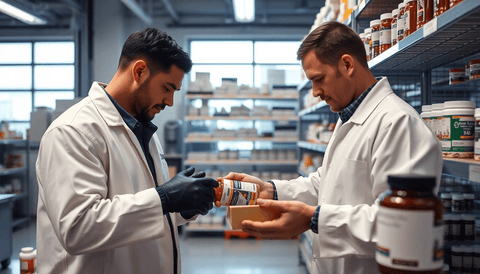
Third-party supplement testing is the process of having an independent laboratory verify that a supplement contains what its label claims, in the stated amounts, without harmful levels of contaminants. In this guide, you'll learn what third-party supplement testing involves, how to read a Certificate of Analysis, which certification programs to trust, and how to use this information to choose safer, more reliable vitamins and minerals. Because supplement regulation has meaningful gaps, independent verification is one of the most practical tools available for checking product quality before you buy.
What Is Third-Party Supplement Testing and Why It Matters
Third-Party Testing Meaning: How It Differs From In-House Quality Checks
Third-party testing means a supplement is analyzed by an independent laboratory that has no financial stake in the brand or the product's sales results. This differs from in-house quality checks, where a manufacturer tests its own products using its own equipment, methods, and staff. While in-house testing can be rigorous, it lacks external accountability—there is no independent party confirming the results.
Independent testing reduces the risk of biased reporting. If a lab's business depends on objective, accredited analysis rather than on product sales, its findings carry more weight. This is why dietitians, pharmacists, and sports organizations typically look for third-party verification when evaluating supplement quality.
What Third-Party Labs Actually Test For: Purity, Potency, and Contaminants
A comprehensive independent analysis typically covers three areas:
- Potency: whether the amount of each vitamin, mineral, or active compound matches the label claim, usually within an accepted tolerance range.
- Purity: whether the product is free from—or contains only negligible levels of—contaminants such as heavy metals (lead, cadmium, arsenic, mercury), pesticide residues, solvent residues, and undeclared allergens.
- Microbiological and physical quality: absence of harmful bacteria, yeast, and mold, plus checks on dissolution and disintegration so the nutrient is actually released in the digestive tract.
Some testing programs also screen for banned substances, which is especially important for athletes.
Key Terms Explained: Certificate of Analysis (COA), Good Manufacturing Practices (GMP), and USP Verification
Certificate of Analysis (COA): a laboratory document showing test results for a specific batch of a product, including what was measured, the results, and the lab's credentials.
Good Manufacturing Practices (GMP): a set of production standards covering facility cleanliness, raw material handling, documentation, and process control. GMP certification describes how a product is made, not necessarily what is in the finished bottle.
USP verification: a voluntary program run by the United States Pharmacopeia, a standards body, in which products are audited and tested against strict quality criteria and may carry the USP Verified Mark if they pass.
Why Supplement Testing Matters for Your Health and Safety
The Supplement Industry's Regulatory Gap: Why FDA Oversight Has Limits
In the United States, dietary supplements are regulated under a framework that places much of the responsibility on manufacturers. Companies are not required to obtain pre-market approval for their products, and the FDA generally becomes involved after a product is on the market—typically in response to complaints, adverse event reports, or inspections. This means a supplement can be sold for years without any independent party verifying its contents. Similar gaps exist in other markets where supplements are treated as foods rather than medicines.
Voluntary third-party testing exists largely to fill this gap. It shifts quality assurance from a promise to a verifiable result.
Real Risks of Untested Supplements: Heavy Metals, Fillers, and Mislabeling
Independent surveys and laboratory studies have repeatedly found problems in the supplement supply. Published analyses have detected heavy metals in some mineral and botanical products, found products containing substantially less (or more) active ingredient than labeled, and identified undeclared fillers or even pharmaceutical compounds in products marketed as natural. Not every untested product is problematic—but without verification, there is no way to know which ones are.
How Label Inaccuracy Affects Your Dosage and Nutrient Intake
If a product contains less of a nutrient than labeled, someone relying on it to address a low intake may unintentionally continue to fall short. If it contains more, a person could exceed intended amounts—particularly relevant for nutrients with established upper intake limits, such as vitamin A, vitamin D, iron, and selenium. Over years of use, these discrepancies can meaningfully change total nutrient exposure, especially in people taking multiple products.
Common Problems Third-Party Testing Uncovers
Ingredient Mismatches: When the Label Doesn't Match the Bottle
Ingredient mismatches range from minor potency deviations to products containing entirely different compounds than advertised. Botanical supplements are particularly vulnerable: studies have used DNA barcoding to show that some herbal products contain substituted species or diluted material. For standardized botanical extracts such as curcumin or ashwagandha, verifying the concentration of the active marker compound matters as much as verifying the plant itself.
Contamination Risks: Heavy Metals, Pesticides, Microbes, and Banned Substances
Contamination can enter at multiple points—soil where botanicals are grown, shared manufacturing equipment, or adulteration of raw materials. Common findings include:
- Heavy metals in mineral-based and plant-derived products
- Pesticide residues in botanicals
- Microbial contamination in powders and probiotics
- Undeclared stimulants or banned substances in products marketed for weight loss, energy, or sports performance
Underdosed and Overdosed Products: Why Potency Verification Matters
Potency problems run in both directions. Underdosed products may deliver far less of the nutrient than the label suggests. Overdosed products are equally concerning: a vitamin D or B6 product containing several times the labeled amount can push long-term users above tolerable upper intake levels without them realizing it. Independent potency testing is the only reliable way to confirm the dose you're actually taking.
Who Is Most Vulnerable to Untested or Poor-Quality Supplements
Higher-Risk Groups: Pregnant Women, Children, Older Adults, and People on Medication
Some groups have less tolerance for dosage errors or contaminants. Pregnant women have specific, carefully calibrated nutrient needs—folate, iodine, iron, and vitamin D requirements change during pregnancy, and excess vitamin A is a known concern. Children are more sensitive to heavy metals and dose errors relative to body weight. Older adults may have reduced kidney and liver function that affects how they handle excess nutrients. People taking medications face interaction risks that become harder to manage when a product's actual contents are unknown.
Athletes and Banned Substance Contamination in Sports Supplements
Anti-doping organizations have documented cases where athletes tested positive after using supplements contaminated with banned stimulants or anabolic agents—sometimes as a result of cross-contamination on shared production lines. For competitive athletes, certification programs such as NSF Certified for Sport or Informed Sport test products specifically for substances on banned lists. Anyone considering sports supplements at a competitive level should treat this screening as essential rather than optional.
People With Allergies, Intolerances, or Dietary Restrictions
If you avoid gluten, dairy, soy, or shellfish, undeclared allergens are a direct safety issue. Testing that verifies allergen claims matters. Similarly, people following vegan or vegetarian diets may need confirmation that capsule shells, vitamin D3 sources, or omega-3 products are genuinely plant-derived as claimed.
How to Read a Certificate of Analysis (COA)
What a COA Shows: Batch Numbers, Test Results, and Lab Credentials
A legitimate COA identifies the specific product and batch number, lists each parameter tested (e.g., vitamin D potency, lead content, microbial counts), states the result alongside the accepted specification, and identifies the testing laboratory. A COA that matches your product's batch number confirms that the results apply to the exact batch you're holding—not an earlier or hypothetical version of the product.
Red Flags on a COA: Missing Data, Vague Labs, or Mismatched Batch Numbers
Watch for:
- A batch number that doesn't match your bottle
- Missing test dates or missing results for key parameters
- Labs identified only by a generic name with no address, accreditation, or contact details
- Documents with altered formatting or results that conveniently match the label exactly on every parameter
- A COA provided for one product but marketed as applying to a whole brand
Accreditation Matters: ISO/IEC 17025 Labs and What They Mean
ISO/IEC 17025 is the international standard for testing and calibration laboratories. An accredited lab has demonstrated technical competence, validated methods, and regular external audits. When checking a COA, look for ISO/IEC 17025 accreditation or equivalent recognition—it substantially increases confidence that the results are reliable.
Trusted Third-Party Certification Programs to Look For
USP Verified Mark: What It Confirms About a Supplement
The USP Verified Mark indicates a product has passed periodic facility audits and independent testing confirming identity, potency, purity, and manufacturing quality. It is one of the longest-running and most widely recognized verification programs for dietary supplements.
NSF Certified for Sport and NSF/ANSI 173: Testing Standards Explained
NSF/ANSI 173 is the American National Standard for dietary supplements, covering content testing and contaminant screening. NSF Certified for Sport goes further, adding screening for substances banned by major sports organizations. Products carrying these marks have undergone facility inspections plus ongoing batch testing.
Informed Choice and Informed Sport: Certification for Athletes
Informed Sport (widely used in the UK and Europe) and Informed Choice test every production batch for banned substances against the WADA prohibited list context. For athletes subject to drug testing, these programs offer batch-level assurance rather than periodic sampling.
ConsumerLab, Labdoor, and Consumer Reports: Independent Testing Reviews
Organizations such as ConsumerLab.com, Labdoor, and Consumer Reports buy products at retail and test them independently, publishing results and ratings. These reviews are useful because the tested samples reflect what consumers actually purchase—not samples provided by manufacturers.
Third-Party Testing vs. Other Quality Claims on Labels
"GMP Certified" vs. "Third-Party Tested": What's the Difference?
GMP certification describes manufacturing conditions; third-party testing describes verified finished-product content. Both are valuable, but they answer different questions. A GMP-certified facility can still produce an underdosed product if the formulation or raw materials are wrong. Ideally, look for both: good manufacturing practices plus independent verification of the finished product.
Marketing Claims That Don't Guarantee Quality: "Pure," "Pharmaceutical Grade," and "Clinically Proven"
Terms like "pharmaceutical grade," "pure," "premium," and "clinically proven" are largely unregulated marketing language when used on supplement labels. "Clinically proven" often refers to an ingredient studied in isolation, not the specific product formulation. These claims do not substitute for a COA or a recognized certification mark.
Proprietary Blends and Why They Complicate Transparency
A proprietary blend lists combined ingredients under a single total weight without disclosing individual amounts. This makes it impossible to know whether any ingredient is present at the dose used in research. Third-party testing can verify total content, but it cannot restore per-ingredient transparency that the label withholds. Products with fully disclosed doses are generally easier to evaluate.
Third-Party Testing and Choosing the Right Supplement
Verified Potency and Bioavailability: Why the Form of a Nutrient Matters
Testing confirms how much of a nutrient is present, but the chemical form affects how well your body absorbs and uses it. Magnesium, for example, varies widely—oxide is poorly absorbed while citrate and glycinate forms are generally better absorbed, though evidence comparing forms is still developing. Similarly, vitamin D3 is generally preferred over D2 for raising and maintaining blood levels. When evaluating products, consider both verified potency and form. Our guide to magnesium supplements covers these differences in more detail.
Dosage Accuracy: Matching the Label to What's Actually in the Bottle
Once potency is verified, compare the actual dose to established reference intakes and upper limits rather than to marketing claims. More is not automatically better: for fat-soluble vitamins (A, D, E, K) and several minerals, intake accumulates in the body, and long-term use above recommended levels carries risks. The same applies to multivitamins, where combined intake from multiple products can exceed upper limits.
Single Ingredients vs. Combination Products: How Testing Applies to Each
Single-ingredient products are easier to verify—there is one potency result to check and fewer opportunities for ingredient interactions or fillers. Combination products require testing for each active ingredient, and quality issues in one component can compromise the whole formula. Neither format is inherently superior, but single-ingredient products make it simpler to adjust doses to your individual needs.
Checking for Allergens, Additives, and Fillers on Tested Products
A thorough COA or certification audit also covers excipients—binders, coatings, flow agents, and fillers. While most are harmless, some people prefer to avoid specific additives, and undeclared allergens are a genuine safety concern. Look for explicit allergen statements supported by testing rather than blanket "allergen-free" claims.
Capsules, Tablets, Powders, and Liquids: Does Format Affect Quality?
Format affects stability, shelf life, and disintegration more than absorption for most nutrients. Tablets are stable and inexpensive but must dissolve properly—dissolution testing (part of third-party analysis) confirms this. Powders and liquids offer dosing flexibility but can be more vulnerable to moisture, oxidation, and shorter shelf life. Choose a format you will take consistently; a well-tested product in a form you actually use beats a theoretically superior one you abandon.
How to Verify a Supplement's Testing Status Before You Buy
Step-by-Step: Finding and Checking a Product's COA Online
- Step 1: Check the product page or packaging for a COA link, QR code, or certification mark.
- Step 2: Open the COA and confirm the product name and batch number match your bottle.
- Step 3: Verify the lab's name and look for ISO/IEC 17025 accreditation or equivalent.
- Step 4: Review the results: potency within tolerance, contaminants below thresholds, no missing parameters.
- Step 5: Check the test date—it should correspond to a recent batch.
Questions to Ask Brands About Their Testing Practices
- Do you test every batch or only periodic samples?
- Is testing performed by an ISO/IEC 17025–accredited independent lab?
- Can you provide a COA for the specific batch I would receive?
- Do you test for heavy metals, pesticides, and microbiological contamination?
- Do your manufacturing facilities hold any third-party certification (e.g., NSF, USP)?
Red Flags When a Brand Won't Share Test Results
A brand that refuses to provide a COA, cites "proprietary" testing methods as a reason not to share results, or responds with marketing materials instead of laboratory documents is asking you to take quality on faith. Transparent brands make COAs easy to find. Secrecy around testing—especially for botanical, mineral, or sports products—warrants caution.
When Supplementation Makes Sense — and How Testing Fits In
Food First: Why Diet Should Come Before Supplements
A varied diet rich in vegetables, fruits, whole grains, legumes, fish, eggs, and dairy (or fortified alternatives) provides nutrients in forms and combinations the body is well adapted to absorb, along with fiber and phytochemicals no pill replicates. For most nutrients, a balanced diet is the appropriate starting point, and supplementation is best viewed as a targeted tool rather than a dietary foundation.
Situations Where Supplements May Be Helpful: Restricted Diets, Life Stages, and Low Intake
Supplementation may be worth considering when intake is demonstrably low or requirements are elevated—for example, vegan diets (vitamin B12, iodine, sometimes iron and omega-3), limited sun exposure (vitamin D), pregnancy (folate and other prenatal nutrients), older age (vitamin D and B12 absorption often declines), and restricted diets due to allergies or medical conditions. In these situations, the reliability of the product becomes more important—someone taking a supplement to fill a specific gap depends on that supplement actually delivering its stated dose. Choosing products with independent verification, such as vitamin D or B-vitamin products with published testing, reduces that uncertainty.
Why Testing Matters More When You Take Supplements Long-Term
Short-term use of a slightly off-spec product has limited consequences. Long-term daily use magnifies errors: a persistent 50% potency shortfall or an undetected contaminant accumulates into a meaningful deviation from intended intake over months and years. If you take supplements continuously, prioritize verified products and periodically reassess whether you still need them.
Safety Considerations and When to Seek Professional Advice
Why Accurate Labeling Is a Safety Issue: Interactions and Upper Intake Limits
Accurate labels underpin safe use. Nutrients such as vitamin K can affect blood-thinning medications like warfarin; high-dose vitamin E may influence bleeding risk; vitamin B6 in sustained high doses has been associated with peripheral neuropathy; and excess iron is dangerous for people with hemochromatosis. If the label doesn't reflect actual content, neither you nor your healthcare provider can properly account for these interactions. Adhering to tolerable upper intake levels requires knowing real doses.
Talking to Your Doctor or Pharmacist About Supplements You Take
Bring your supplements—including brands and doses—to appointments the same way you bring medications. Pharmacists in particular can screen for nutrient–drug interactions and redundancies across products. This conversation is far more productive when product contents are verified rather than assumed.
When Blood Testing and Professional Assessment Are More Reliable Than Guessing
Symptoms alone rarely confirm a nutrient deficiency—fatigue, for instance, has many possible causes. Where validated tests exist (vitamin D status, B12, ferritin, thyroid-related iodine function), blood testing provides far more useful information than symptom-based guessing. A healthcare provider can interpret results in context, determine whether supplementation is warranted, and set an appropriate dose and monitoring plan. Third-party product testing and clinical testing answer different questions: one verifies what's in the bottle, the other verifies what's in your body.
How to Decide: A Practical Checklist for Choosing Tested Supplements
Diet Alone or Supplementation? Questions to Help You Decide
- Is a specific dietary gap or elevated need documented or strongly suspected (e.g., vegan B12, low sun exposure for vitamin D)?
- Can dietary changes realistically close the gap first?
- Has blood testing confirmed low status, or is this based on general symptoms?
- Am I in a life stage or health situation with increased requirements?
If the answer to most of these is "no," improving diet may be sufficient. If supplementation is justified, product quality becomes the next decision.
Your Pre-Purchase Checklist: Certification, COA, Dosage, and Transparency
- Certification: look for USP Verified, NSF, Informed Sport, or an accessible batch-specific COA from an accredited lab.
- Dosage: the labeled dose is meaningful relative to reference intakes and upper limits, not to marketing.
- Form: the nutrient form is appropriate for your goals and tolerability (e.g., D3 vs. D2, magnesium citrate vs. oxide).
- Transparency: full ingredient disclosure, no hidden proprietary blends where dosing matters, and clear allergen information.
- Necessity: you can articulate why you need this specific product—not just that it seems healthy.
Key Takeaways
- Third-party supplement testing uses independent, accredited laboratories to verify potency, purity, and label accuracy—something manufacturers cannot credibly confirm about their own products.
- Regulatory oversight of supplements is largely reactive, so independent verification fills an important safety gap.
- A Certificate of Analysis (COA) should match your product's batch number and come from an ISO/IEC 17025–accredited lab.
- Recognized certification marks include USP Verified, NSF/ANSI 173, NSF Certified for Sport, and Informed Sport.
- Marketing terms like "pharmaceutical grade" and "pure" are not quality guarantees; tested results are.
- Untested products can be underdosed, overdosed, or contaminated with heavy metals, pesticides, or banned substances.
- Accurate labeling is a safety issue for pregnant women, children, older adults, people on medications, and long-term users.
- Athletes should choose products with banned-substance screening specific to every batch.
- Diet should come first; supplementation is most justified when intake is low, needs are elevated, or testing shows low nutrient status.
- Blood testing and professional advice are more reliable than symptoms for assessing your actual nutritional status.
Frequently Asked Questions
What does "third-party tested" mean on a supplement label?
It means an independent laboratory, unaffiliated with the manufacturer, analyzed the product for potency, purity, and contaminants. The label claim itself is not regulated, so ask for the COA or certification mark to confirm the claim is real.
Is third-party testing required by law for supplements?
No. In most markets, including the United States, independent testing is voluntary. Manufacturers must follow certain manufacturing requirements, but finished products generally do not need independent verification before sale.
How can I check if a supplement is third-party tested?
Look for a certification mark (USP, NSF, Informed Sport) on the packaging or a COA link on the brand's website. Confirm the COA's batch number matches your bottle and that the lab is ISO/IEC 17025 accredited.
Does GMP certification mean a supplement is third-party tested?
No. GMP certification addresses manufacturing conditions and process controls. A GMP-certified facility can still produce mislabeled products; finished-product testing is a separate verification step.
Are supplements with the USP Verified Mark guaranteed to work?
The USP mark confirms identity, potency, purity, and manufacturing quality—not clinical effectiveness. It means the product contains what it claims at verified levels, which is a meaningful quality assurance but not a promise of health outcomes.
Why do athletes need specially tested supplements?
Supplements have been found contaminated with banned stimulants and other prohibited substances, sometimes through cross-contamination. Programs like NSF Certified for Sport and Informed Sport test every batch for banned substances, protecting athletes from inadvertent positive drug tests.
What is a Certificate of Analysis (COA)?
A COA is a lab document reporting test results for a specific product batch, including potency measurements, contaminant screening, and the identity and credentials of the testing laboratory. It should be batch-specific and current.
Can a supplement contain more of a nutrient than the label states?
Yes. Overdosing errors occur and can be significant, particularly with fat-soluble vitamins and minerals that accumulate in the body. This is why potency verification matters even for nutrients generally considered safe.
Do natural or herbal supplements need third-party testing?
Arguably more so. Botanical products are vulnerable to species substitution, variable active-compound content, pesticide residues, and heavy metals absorbed from soil. DNA and chemical testing help confirm identity and concentration.
Does the format of a supplement (capsule, tablet, powder) affect quality?
Format mainly affects stability, shelf life, and how reliably the product dissolves. Dissolution testing is part of third-party analysis. No format is universally superior; consistency of use matters most.
Should I get a blood test before taking supplements?
For nutrients like vitamin D, B12, and iron, blood testing provides far more reliable information than symptoms alone. Testing is especially worthwhile before long-term or high-dose supplementation, and results should be interpreted with a healthcare provider.
What should I do if a brand won't share its COA?
Treat it as a caution signal. Reputable manufacturers make test results easily accessible. If a brand refuses, cites confidentiality, or provides marketing documents instead of lab results, consider choosing a more transparent alternative.
Final Takeaway: Informed Choices Start With Verified Quality
Nutritional needs are individual—shaped by diet, age, life stage, sun exposure, medications, and health status—and symptoms alone rarely reveal what your body actually needs. Food should be your foundation, and supplementation works best as a targeted, justified addition rather than a default. When you do choose a supplement, third-party testing is what turns a label claim into a verified fact. Check for recognized certifications, read the COA, match doses to evidence-based reference ranges, and involve a healthcare professional when dosage, interactions, or long-term use are in question. Verified quality doesn't guarantee outcomes—but it ensures the product you choose contains exactly what you intended to take, which is the first step in any sensible supplement decision.
Related Keywords
- third-party supplement testing
- certificate of analysis (COA) supplements
- supplement label accuracy
- USP Verified supplements
- NSF Certified for Sport
- ISO/IEC 17025 lab testing
- heavy metals in supplements
- supplement purity and potency testing
- GMP certified supplement manufacturing
- supplement quality verification
- informed sport certified products
- supplement contaminants testing
- how to read a supplement COA
- bioavailability of vitamin forms