Entfalte Höchstleistungen: Durchbrüche in der fortschrittlichen Nahrungsergänzungstechnologie


Entdecken Sie Durchbrüche in der fortschrittlichen Zusatzzutaten-Technologie, bei der interdisziplinäre Wissenschaft auf Präzisionsengineering trifft. Dieses Gebiet verbindet Formulierungswissenschaft, Materialwissenschaft und datengetriebene Entwicklung, um robuste, reproduzierbare Plattformen und Produkte zu schaffen. Durch die Fokussierung auf die Kernprinzipien der fortschrittlichen Zusatzzutaten-Technologie beschleunigen Teams Forschungszyklen, validieren Konzepte mit rigorosen Methoden und gewährleisten Konsistenz über Chargen hinweg. Der Schwerpunkt liegt auf Messung, modularen Plattformen und wiederholbaren Prozessen, die kontinuierliche Verbesserungen ermöglichen. Wissenschaftlich untermauerte Formeln: Die Grundlage verantwortungsvoller Innovationen liegt in evidenzbasierter Entwicklung. Innerhalb der fortschrittlichen Zusatzzutaten-Technologie verlassen sich Teams auf transparente Benchmarking, peer-reviewed Validierungen und reproduzierbare Protokolle, um Wechselwirkungen, Stabilität und Zuverlässigkeit der Formulierung zu überprüfen – ohne gesundheitsbezogene Ergebnisse zu behaupten. Analytische Strenge umfasst hochpräzise Analysen, standardisierte Tests und verantwortungsbewussten Daten-sharing innerhalb von Sicherheits- und Compliance-Grenzen. Dieser Ansatz trägt dazu bei, dass Formulierungen unter realen Bedingungen vorhersehbar funktionieren. Intelligente Lieferung und Materialwissenschaft: Die fortschrittliche Zusatzzutaten-Technologie umfasst Kapselung, kontrollierte Freisetzungsmatrizen und innovative Träger, die entwickelt wurden, um Integrität zu schützen und konsistente Freisetzungsprofile zu gewährleisten. Durch die Anpassung des Löslichkeitsverhaltens und der Lagerstabilität reduzieren diese Lieferplattformen Variabilität zwischen Produktionschargen. Die Integration in digitale Dosierungsökosysteme ermöglicht Rückverfolgbarkeit, Qualitätskontrolle und benutzerfreundliche Erfahrungen – stets bei strengen Standards für Zuverlässigkeit und Leistung. Sicherheit an erster Stelle bei Forschung und Governance: Jeder Schritt wird von Sicherheitsaspekten, regulatorischer Einhaltung und strengen Risikoabschätzungen geleitet. Qualitätssysteme, GMP, Lieferantenqualifikation und ein robustes Risikomanagement bilden die Grundlage für Entwicklungsprogramme. Kontinuierliche Überwachung nach Markteinführung, transparente Dokumentation und ständige Verbesserungszyklen helfen, hohe Standards und Verantwortlichkeit aufrechtzuerhalten. Mit Fokus auf Nachhaltigkeit und ethische Beschaffung zielt die fortschrittliche Zusatzzutaten-Technologie darauf ab, verantwortungsvoll voranzukommen und gleichzeitig strenge Branchenstandards zu unterstützen.


What are Liposomal Supplements and Are They More Effective? - Topvitamine
August 29, 2025
Liposomale Nahrungsergänzungsmittel verpacken Nährstoffe in Phospholipid-Strukturen. Das kann die Stabilität und Aufnahme bestimmter Wirkstoffe verbessern, bedeutet aber nicht automatisch eine stärkere Wirkung als bei Tabletten oder Kapseln. Dieser Ratgeber erklärt die Technologie, vergleicht Darreichungsformen und zeigt, worauf Sie bei Vitamin C, Coenzym Q10 und anderen Präparaten achten sollten. Außerdem beantwortet er häufige Fragen zu Qualität, Marken und Sicherheit.

Advanced supplement technology represents the convergence of modern science and precision engineering in the nutritional supplement industry. This field is fundamentally changing how supplements are designed, manufactured, and delivered. Rather than focusing solely on which nutrients are included, advanced technology also examines how those nutrients are processed, protected, and made available to the body. This guide explores the broad landscape of this innovative area, from the core principles of formulation to the sophisticated delivery systems that define the next generation of supplements.

What Is Advanced Supplement Technology?

At its core, advanced supplement technology is an interdisciplinary field that applies principles from materials science, chemistry, and engineering to nutritional products. It aims to solve common challenges in the supplement industry, such as ingredient stability, inconsistent absorption, and the difficulty of delivering certain compounds effectively. This is often achieved through sophisticated manufacturing processes and innovative delivery systems. The emphasis is on building robust, reproducible platforms that can consistently produce high-quality supplements, underpinned by rigorous testing and quality control.

This approach shifts the focus from just the active ingredients to the entire lifecycle of the product—from raw material sourcing to the final form that reaches the consumer. This includes considerations like the stability of a nutrient in different environments, how it interacts with other ingredients, and how it is released in the digestive system. It is a holistic, data-driven approach to supplement creation.

Core Concepts in Supplement Innovation

Understanding a few key concepts is essential to grasping how advanced supplement technology works. These concepts are the building blocks of modern product development and help explain why one supplement might be more effective than another with a similar label.

A primary goal of many advanced technologies is to enhance bioavailability. This term refers to the degree and rate at which a substance is absorbed into the bloodstream and becomes available for the body to use. High bioavailability is often a desired trait, though the methods to achieve it can vary greatly.

Key Terminology

  • Bioavailability: The proportion of a nutrient that is absorbed and utilized by the body.
  • Delivery System: The technology used to carry, protect, and release the active ingredient ( e.g., tablet coating, capsule, liposome).
  • Controlled Release: A method of releasing an ingredient slowly over time, rather than all at once.
  • Encapsulation: The process of coating or enclosing an ingredient in a protective shell or matrix.
  • Formulation Science: The discipline of combining ingredients in a stable and effective manner.

Major Types of Delivery Systems

A significant portion of advanced supplement technology focuses on how ingredients are delivered. Different technologies are employed to address specific challenges related to the ingredient's nature or the desired effect. Below are some of the most prominent categories.

Encapsulation and Nanoencapsulation

Encapsulation involves enclosing an ingredient within a protective layer. This can shield sensitive nutrients from environmental factors like light, heat, or oxygen, which can degrade their quality. Nanoencapsulation refers to this process on a microscopic scale. These tiny particles may offer unique properties in how they interact with the digestive environment, potentially improving solubility or absorption. These methods are often used for ingredients that are delicate or have poor inherent stability.

Liposomal Delivery

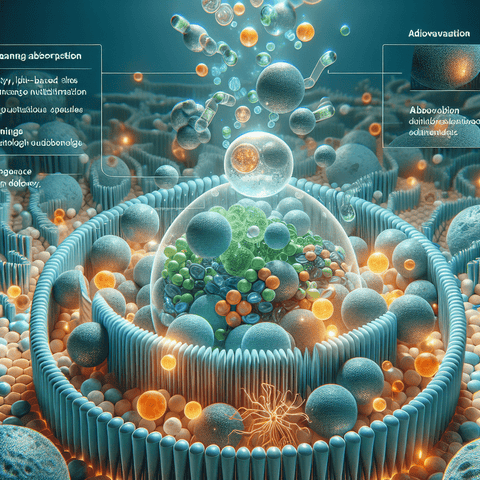
Liposomes are tiny spherical vesicles composed of a lipid bilayer, similar to the membranes found in cells. Nutrients can be encapsulated inside this lipid layer. This approach is particularly relevant for both fat-soluble and water-soluble compounds, as the liposomal structure can protect the nutrient and potentially facilitate its passage through the digestive tract. Liposomal technology is one of the most well-known examples of a sophisticated delivery system, though its advantages over other forms can vary depending on the specific nutrient.

Controlled-Release and Timed-Release Matrices

Controlled-release technologies use specialized matrices or coatings to slow down the release of an ingredient in the body. This can be useful for nutrients that are better absorbed in smaller amounts over an extended period or for those that might cause stomach upset if released all at once. Timed-release formats aim to deliver a nutrient at a specific point in the digestive process for optimal absorption. This technology seeks to provide a steady supply of the nutrient, rather than a single peak.

Science, Safety, and Quality Assurance

Behind every innovative delivery system is a framework of scientific rigor and quality control. Advanced supplement technology relies heavily on evidence-based development. This means that decisions are guided by data, transparent research protocols, and rigorous testing rather than anecdote alone. The goal is to ensure that formulations perform predictably and consistently.

The Role of Analytics and Testing

Analytical rigor is a cornerstone of responsible innovation. This involves using high-precision analytics to verify the identity, purity, and potency of ingredients. Standardized testing methods are employed to check for contaminants and to measure the stability of the final product over time. This data is crucial for confirming that the product contains what is stated on the label and that it remains effective up to its expiry date. Responsible data sharing, within safety and compliance boundaries, also contributes to the broader scientific understanding of these technologies.

Adherence to Good Manufacturing Practices (GMP)

Safety-first research and governance are guided by adherence to established quality systems, including Good Manufacturing Practices (GMP). GMP provides a framework for ensuring that products are consistently produced and controlled according to quality standards. This includes requirements for facilities, equipment, personnel, and documentation. Supplier qualification processes ensure that raw materials meet strict criteria. Robust risk management strategies help identify and mitigate potential hazards at every stage of the development process.

Comparing Advanced Technologies

With various technologies available, consumers may wonder which is “best.” The reality is that there is often no single superior technology. The most appropriate choice depends on the specific nutrient, its chemical properties, the desired release profile, and the intended use of the supplement. A simple comparison illustrates this point:

  • Liposomal technology may be explored for ingredients where protecting them from digestive breakdown is a priority.
  • Nanoencapsulation might be used to enhance the solubility of poorly water-soluble compounds.
  • Timed-release technology could be beneficial for nutrients that are better absorbed in divided doses or for improving tolerability.

Ultimately, the efficacy of a supplement depends on a combination of the right ingredient, the appropriate dose, and a suitable delivery system. Different technologies are tools for formulators to optimize the final product for a specific purpose.

Practical Considerations for Consumers

For those interested in supplements, understanding these technologies can inform purchasing decisions. When evaluating a product, it can be helpful to look for evidence of quality manufacturing, such as GMP certification or third-party testing. Transparency about the technology used can also be a positive sign. However, it is important to remember that advanced technology does not replace the need for a balanced diet and healthy lifestyle. Supplements are intended to complement, not substitute for, a nutritious diet.

Furthermore, it is always advisable to discuss any new supplement regimen with a healthcare professional, especially if you have underlying health conditions or are taking medications. They can provide personalized advice and help you interpret information about different supplement technologies. The decision to use a supplement should be based on individual nutritional needs and professional guidance, not just the novelty of the technology.

Exploring Related Supplement Topics

Understanding advanced delivery technology is just one piece of the puzzle in nutritional science. The effectiveness of any supplement also depends heavily on the nutrient itself and how it functions in the body. To build a more complete picture, you may find it useful to explore specific nutrients and supplement categories.

For example, learn about the importance of foundational minerals like magnesium which is involved in numerous bodily functions. Similarly, understanding curcumin supplements highlights how delivery systems can be crucial for ingredients with poor natural absorption. And for scientific insights into nutrient synergy, exploring the broad category of multivitamins can be a great starting point. These resources offer deeper knowledge that complements the concepts of advanced supplement technology.