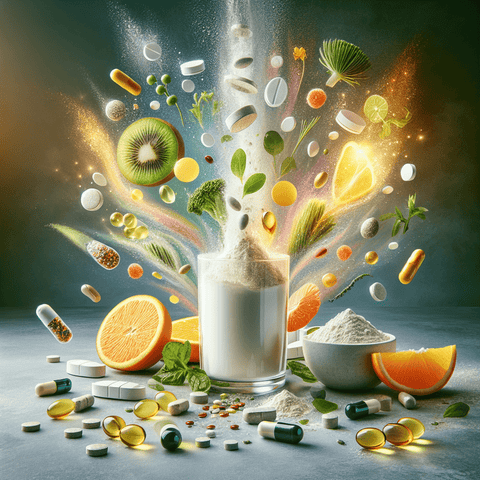
Pulver gegen Kapselaufnahme: Welche liefert Nährstoffe schneller?


Pulver versus Kapsel-Absorption hängt davon ab, wie die Darreichungsform mit den Verdauungsprozessen des Körpers interagiert. Pulver löst sich typischerweise auf oder dispersiert, wenn es mit Flüssigkeit vermischt wird, was mehr Oberflächenkontakt schafft und potenziell eine schnellere Freisetzung der Inhaltsstoffe in den Magen-Darm-Trakt ermöglicht. Kapseln umschließen die Inhaltsstoffe in Hüllen, die sich vor der Freisetzung auflösen müssen, was den gesamten Ablauf verzögern kann. Da jedoch Formulierungsdetails wie Partikelgröße, Füllstoffe und Kapseldesign variieren, ist die relative Geschwindigkeit der Absorption von Pulver gegenüber Kapseln nicht universell und hängt vom jeweiligen Produkt ab. Die Digestivebiologie spielt eine zentrale Rolle darin, wie diese Formen sich verhalten. Im Magen beginnen mechanisches Mischen und saure Bedingungen, Substanzen abzubauen, und wie leicht sich ein Pulver dispergiert oder wie schnell sich eine Kapselhülle auflöst, kann die frühzeitige Verfügbarkeit beeinflussen. Im Dünndarm bestimmen Faktoren wie Löslichkeitsrate, Transitzeit und Interaktionen mit Verdauungsenzymen, wie die Inhalte die Darmwand erreichen. Einige Kapseln sind für eine schnelle Freisetzung konzipiert, während andere Überzüge oder verzögerte Freisetzungsmechanismen verwenden, die den Ablauf im Vergleich zu einem einfachen Pulver, das mit Flüssigkeit vermischt wird, verändern können. Praktische Überlegungen beim Vergleich der Absorption von Pulver und Kapseln umfassen das Überprüfen der Produktetiketten auf Freisetzungsprofile (wie sofortige oder verlängerte Freisetzung) und die Anwendungsempfehlungen. Wenn die sofortige Dispergierung gewünscht ist, wird möglicherweise eine Pulvervariante mit geeigneter Flüssigkeit bevorzugt; bei Tragbarkeit oder präziser Dosierung könnte eine Kapsel besser geeignet sein. Ebenso sollte man den Verdauungszustand und die Zeitplanung mit Mahlzeiten berücksichtigen, da diese beeinflussen können, wie schnell eine Form die Inhaltsstoffe freisetzt und wie der Körper sie verarbeitet. Hydration und konsistente Anwendungsmuster können eine Rolle im Gesamterlebnis spielen, wobei die genauen Effekte von der jeweiligen Formulierung abhängen. Kurz gesagt, die Absorption von Pulver versus Kapsel spiegelt die Interaktion von Lösung, Verdauung und Freisetzungsdesign wider. Durch die Untersuchung von Freisetzungseigenschaften, Löslichverhalten und wie eine bestimmte Darreichungsform mit der eigenen Routine zusammenpasst, lassen sich Optionen besser vergleichen. Diese Übersicht ist informativ und stellt keinen Ersatz für professionelle Beratung dar; konsultieren Sie bei Bedarf eine fachkundige Quelle oder Produktexperten, um eine auf die jeweilige Formulierung zugeschnittene Empfehlung zu erhalten.


Are powdered supplements absorbed faster than pills - Topvitamine
August 27, 2025
Ob Pulver, Tabletten, Kapseln oder Tropfen besser geeignet sind, hängt nicht allein von der Darreichungsform ab. Pulver und Flüssigpräparate können sich schneller verteilen, sind aber nicht automatisch besser bioverfügbar. Entscheidend sind der Nährstoff, seine chemische Form, die Formulierung, die Einnahme mit oder ohne Mahlzeit und die regelmäßige Anwendung. Dieser Vergleich erklärt die wichtigsten Unterschiede und beantwortet praktische Fragen zu Vitamin D, Vitamin B12 und flüssigen Vitaminen.

The debate between powder and capsule supplements is common among health enthusiasts. The core of the issue is absorption, or how well your body can use the nutrients you ingest. This page provides a broad overview of the topic, covering the key differences between these forms, the science of digestion, and practical factors to help you decide which might fit your routine. Whether you are new to supplements or looking to refine your approach, this guide serves as a starting point for comparing powder vs capsule absorption.

What Does Absorption Mean for Supplements?

Supplement absorption is a complex process that determines how much of the active ingredient reaches your bloodstream. It’s more than just swallowing a pill or drinking a shake; it’s about how the form of the supplement interacts with your digestive tract. Both powders and capsules are designed to deliver nutrients, but they have different physical properties that influence their breakdown and release. Understanding these differences is the first step to comparing powder vs capsule absorption.

The efficiency of absorption can be influenced by several factors, from the composition of the supplement to the state of your own digestive system. For instance, the presence of fats in a meal can enhance the absorption of fat-soluble vitamins like A, D, E, and K. Similarly, your individual gut health and motility play a role in how quickly and effectively substances move through your system. This page explores the broad dimensions of this topic, providing a high-level view of how form and digestion interact.

Digestion and Dissolution: How Form Affects Release

The journey of a supplement from ingestion to absorption is a multi-step process. When you consume a powder mixed with liquid, it begins to spread out, creating a large surface area that can be readily processed. In contrast, a capsule represents a more concentrated package; its outer shell must first dissolve in the stomach or intestines before the contents can be exposed and broken down. This difference in physical dispersion is the primary reason why the speed of release can vary.

However, this is a simplified view. The design of the capsule matters, too. Some capsules are designed to dissolve quickly, while others are formulated to provide a delayed release. Powders can also vary in particle size, which affects how quickly they dissolve. Therefore, the type of supplement, its specific formulation, and the presence of other ingredients (like fillers or binders) all contribute to the final absorption profile. The choice between a powder and a capsule is often about finding a product whose release mechanism aligns with your intended use.

Comparing Delivery and Bioavailability

Bioavailability is a key concept to understand. It refers to how much of a nutrient is absorbed and used by your body. While it might seem that a powder, with its faster initial release, would always have higher bioavailability, that is not necessarily the case. A well-formulated capsule can deliver nutrients just as effectively, particularly if it uses technology to enhance absorption. The biological environment, such as your stomach acid and enzyme levels, will process both forms differently.

When considering powder vs capsule absorption, it's essential to look beyond the speed of release. The most 'effective' form is often the one you will take consistently and correctly. If you struggle to swallow pills, a powder may be more practical. If you need a precise dose, a capsule might be superior. Understanding these practical dimensions is as important as the biological ones. Let's look at some high-level comparisons.

Key Differences at a Glance

  • Dispersion: Powders dispersed in liquid have a larger surface area, potentially leading to more immediate contact with digestive juices. Capsules must first undergo shell dissolution.
  • Release Mechanisms: Capsules can be engineered for rapid, delayed, or extended release. Powders generally have a simpler release profile, often immediate if consumed as a shake.
  • Convenience: Powders often require a shaker bottle and a liquid source, which can be less convenient on the go. Capsules are typically more portable and offer pre-measured doses.
  • Ingredient Flexibility: Powders may allow for larger serving sizes and are often used for ingredients that require high doses. Capsules may be preferred for ingredients with a strong taste or odor.

Practical Considerations for Choosing a Form

Your decision shouldn't be based on absorption alone. Consider your daily habits and what is sustainable for you. A supplement you take regularly is far more effective than one you occasionally forget. This means weighing factors like taste, texture, and convenience. Powders allow for flexibility in dosage, while capsules offer a straightforward approach with minimal taste interference.

To learn more about specific nutrients and their recommended forms, you can explore our guides on natural supplements or understand the different types of multivitamins. For those interested in specific minerals, our section on magnesium often discusses the unique absorption profiles of different forms.

Dosage and Bioavailability Factors

Regardless of whether you choose a powder or a capsule, certain factors consistently impact absorption. Taking supplements with the right kind of food can make a significant difference. For example, fat-soluble vitamins are better absorbed with meals containing fat, while some minerals may be better absorbed on an empty stomach, although this can sometimes lead to stomach upset. It is also worth noting that high doses of one mineral can interfere with the absorption of another (e.g., zinc and copper).

Always consult the product label for specific instructions regarding whether to take the supplement with food or water. The best practice is to follow the manufacturer's recommendations, as they have tested the product for optimal use. This practical guidance helps you maximize the potential benefits of your chosen form.

Exploring Specific Supplement Types

The decision between powder and capsule can differ depending on the nutrient. For instance, high-dose vitamin C is often taken as a powder due to the large serving size. Conversely, certain herbal extracts might be more convenient in capsule form. Understanding the nature of the ingredient is as important as understanding the delivery format.

For more targeted information, you might explore our vitamin C collection or our guide on amino acid supplements which are popular in both powder and capsule formats.

Frequently Asked Questions

What is more effective, capsule or powder?

There is no single 'more effective' form. It depends on the specific supplement, its formulation, and your digestive system. A high-quality capsule can be just as effective as a powder. The key is to look for reputable brands and products that use ingredients and technologies designed for good absorption.

What form of supplement is best absorbed?

Absorption depends on the specific nutrient and its form, not whether it comes as a powder or capsule. For example, some minerals are better absorbed as chelates. It is more about the ingredient's chemical structure than the vehicle (powder or capsule) that carries it. A well-designed capsule protects the ingredient, while a mixable powder ensures it is already in a dissolved state.

Is powder or capsules better for supplements?

This comes down to personal preference and lifestyle. Powders are flexible for dosing and often better for larger serving sizes. Capsules are convenient, portable, and mask tastes well. You should also consider your own digestion; some people find powders easier on their stomach, while others prefer the simplicity of a capsule. The best choice is the one that fits your routine and your body's needs.

Do capsules fully dissolve in your stomach?

Most quality capsules are designed to dissolve fully in the digestive tract. However, the time it takes can vary. Gelatin capsules tend to dissolve relatively quickly, while some plant-based or specially coated capsules may be designed to dissolve more slowly for a delayed-release effect. If you ever notice a capsule passing through your system intact, it may be worth discussing with a healthcare professional or the product manufacturer.

Key Takeaways and Further Exploration

Choosing between a powder and a capsule is about more than just absorption rates. It is about finding a product that is effective, convenient, and sustainable for you. Remember that the missing piece is often consistency. By understanding how these forms work with your body, you are better equipped to make an informed choice. This page is a starting point; for deeper dives into specific nutrients or products, explore our other guides and articles.