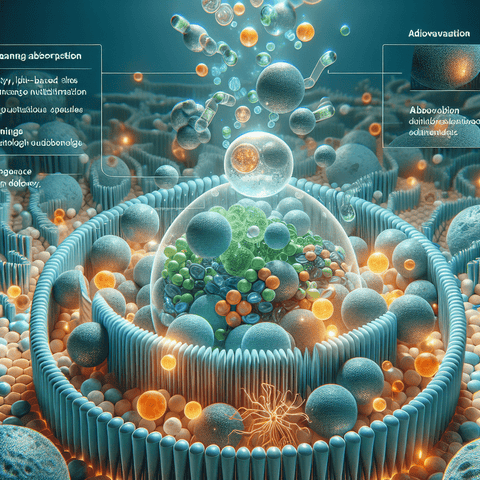
Maximisez l'absorption des vitamines par une livraison liposomale. L'absorption de vitamines liposomales est un terme qui se situe au centre de la science de la formulation, décrivant comment les vecteurs vésiculaires interagissent avec les vitamines dans un système de livraison. Les liposomes sont de minuscules coquilles sphériques formées de phospholipides qui enferment des composés actifs. Lorsque les vitamines sont chargées dans ces vecteurs, leur microenvironnement passe d'une solution simple à un espace structuré et protecteur. Ce résumé décrit comment les systèmes liposomaux sont conçus pour influencer le parcours, de la formulation à la présence mesurable dans un milieu cible, en se concentrant sur la caractérisation et les indicateurs de performance plutôt que sur les revendications produit. Plusieurs facteurs de conception gouvernent l'absorption de vitamines liposomales. La taille des particules, la composition de la membrane et la charge de surface déterminent comment un liposome se comporte dans un milieu donné. Les vitamines hydrophiles et lipophiles se situent dans différentes régions de la vésicule, affectant les stratégies d'encapsulation et la stabilité. Le choix des lipids, la teneur en cholestérol et les modificateurs de surface peuvent modifier la protection contre la dégradation et le profil de libération. Ensemble, ces variables façonnent le concept fondamental de l'absorption de vitamines liposomales sans affirmer de résultats précis. L'efficacité et la minimisation des déchets sont des objectifs pratiques dans la formulation liposomale. L'efficacité d'encapsulation indique la proportion de vitamine de départ qui se trouve à l'intérieur du liposome, tandis que les matériaux non encapsulés peuvent être comptabilisés et gérés dans les flux de traitement. Des méthodes telles que les étapes de purification, le conditionnement et les processus de contrôle qualité aident à réduire les matériaux non liés et la formation de sous-produits. En mettant l'accent sur une encapsulation élevée et des séparations propres, la conception vise à minimiser la perte de matériel et à optimiser l'utilisation des ressources. Libérer le plein potentiel de vos vitamines grâce à une livraison liposomale implique de comprendre le comportement de libération, la compatibilité avec les composants de la formulation et la stabilité dans des conditions de stockage prévues. Les modèles in vitro et les essais analytiques offrent des perspectives sur la manière dont les caractéristiques d'absorption des vitamines liposomales peuvent être interprétées dans un contexte contrôlé. Le langage de l'absorption des vitamines liposomales mélange ainsi la science des matériaux, la caractérisation analytique et l'optimisation des processus, en se concentrant sur la façon dont les vitamines encapsulées sont transportées et libérées dans un système défini.
Absorption de la vitamine liposomale : maximiser la biodisponibilité
Liposomal vitamin absorption represents an important topic in nutritional science and supplement formulation. This page serves as a broad introduction to the subject, explaining what liposomes are, how they function as delivery systems, and which factors determine their behavior. The goal is to provide a clear overview of the science, terminology, and key considerations without making unsubstantiated claims about specific health outcomes. For more detailed information on specific nutrients and their uses, explore our guide on natural supplements.
What Is a Liposome and How Does It Work?
A liposome is a tiny spherical structure composed of one or more phospholipid bilayers, similar to the membranes that surround every cell in your body. This unique composition allows liposomes to encapsulate various substances. Water-soluble (hydrophilic) vitamins sit in the aqueous core, while fat-soluble (lipophilic) vitamins can be housed within the lipid bilayer. This is a fundamental concept in liposomal delivery.
The primary function of a liposome as a delivery vehicle is protection. The phospholipid shell can shield the encapsulated vitamin from degradation in the digestive tract, theoretically allowing more of it to reach the absorption site intact. This protective effect is a key reason why researchers study liposomal systems for enhancing vitamin absorption.
In simple terms, the liposome acts as a protective carrier. It is designed to navigate the body's environment until it releases its contents at a specific location or time. The specific behavior is determined by its formulation, which is a complex process involving several design choices.
Key Formulation Factors in Liposomal Vitamin Absorption
The performance of a liposomal formulation is influenced by its physical and chemical characteristics. These factors are key areas of study in understanding how liposomal vitamin absorption works.
Particle Size and Surface Charge
The size of the liposome and its surface charge are two primary characteristics. Particle size can influence how the liposome interacts with biological barriers. The surface charge can affect its stability in suspension and its interaction with cells. These are measured and optimized during the formulation process.
Lipid Composition and Membrane Stability
The type of phospholipids used, along with the addition of cholesterol or other surface modifiers, determines the rigidity and fluidity of the liposome membrane. A more stable membrane can offer better protection to the encapsulated vitamin, but it may also slow down the release process. The balance between stability and release is a crucial decision in the design.
Encapsulation Efficiency and Stability
Encapsulation efficiency is defined as the percentage of the starting vitamin that is successfully loaded inside the liposome. High encapsulation efficiency is important for minimizing waste and ensuring the product is economically and efficiently produced. Additionally, the formulation must demonstrate stability under expected storage conditions to maintain its performance over time.
How Is Absorption Measured and Evaluated?
In a controlled setting, researchers evaluate liposomal vitamin absorption using various analytical methods. These include in vitro models, which simulate digestive or bodily conditions, to observe how the liposome releases its contents. Key performance indicators include the release profile, which is the rate at which the vitamin is released over time, and the general stability of the formulation.
These tests are fundamental to the development and quality control of liposomal products. They help researchers understand how the system behaves without making direct claims about its effects in the human body. The language of liposomal absorption combines materials science, analytical chemistry, and process optimization to describe how encapsulated vitamins are carried and released.
General Considerations for Supplements
The concept of liposomal delivery is often discussed alongside the general principles of vitamin absorption. When considering any supplement, it is useful to remember that various factors, including diet, lifestyle, and individual health status, can influence how well your body uses nutrients. For example, some vitamins are better absorbed with food, while others may compete for absorption pathways.
This overview is intended to explain the concepts behind liposomal technology. It serves as a foundation for exploring more specific questions about particular vitamins, supplement types, and absorption strategies. For instance, you might be interested in how liposomal delivery applies to a specific vitamin like vitamin C, which you can explore further in our vitamin C guide.
Exploring the Topic Further
There are many specific questions that people ask within the broader topic of liposomal vitamin absorption. These include comparisons between different forms of vitamins, the role of specific ingredients, and practical questions about usage. These detailed subjects are often best explored in dedicated articles, which provides a deeper understanding of a particular question or use case.
This tag page is designed to give you the map: an understanding of the fundamental terms, processes, and scientific concepts. With this foundation, you can more easily evaluate the specific questions and product information you encounter. To learn about the different types of lipids used in these technologies, you can read more about phospholipids.