
Découvrez des vitamines de qualité pharmaceutique : pures, puissantes et fiables. Cette gamme incarne une norme qui dépasse celle des suppléments ordinaires, en mettant l'accent sur la pureté, une puissance constante et une provenance fiable. Notre collection se concentre sur des vitamines de qualité pharmaceutique, testées en laboratoire et appuyées par des pharmaciens pour votre bien-être quotidien. Vous trouverez des détails clairs sur les produits et des engagements de qualité qui vous permettent d'acheter en toute confiance. Chaque lot est testé en laboratoire pour vérifier la puissance et la pureté, avec un dépistage des contaminants réalisé par des laboratoires indépendants. Nous fournissons des certificats d'analyse (COA) pour garantir la transparence, afin que vous puissiez consulter les résultats des tests avant l'achat. Nos pharmaciens vous soutiennent en clarifiant les choix de formulation et en répondant à vos questions sur les ingrédients présents dans les vitamines de qualité pharmaceutique. Cette combinaison de validation en laboratoire et d'accompagnement professionnel renforce la confiance à chaque achat. La qualité commence par la provenance et la formulation. Nous privilégions les ingrédients de qualité pharmaceutique, une fabrication strictement conforme aux bonnes pratiques de fabrication (GMP), et un contrôle rigoureux de nos fournisseurs. Tous les produits font l'objet de contrôles d'allergènes et d'une traçabilité complète, de la matière première jusqu'au produit fini. Les emballages sont conçus pour préserver la puissance et offrir une étiquetage clair pour les vitamines de qualité pharmaceutique, y compris la liste des ingrédients et les instructions de stockage. Achetez en privilégiant votre bien-être quotidien et un service fiable. Nos vitamines de qualité pharmaceutique sont accompagnées d’informations produits simples, de COA transparents et d’un support assuré par des pharmaciens pour vous aider à comparer les options. Profitez d’une expérience d’achat fluide, avec un service client réactif, des retours faciles et une formation continue sur la qualité des produits. Optez pour des vitamines de qualité pharmaceutique pour une base fiable et constante dans votre routine de supplémentation.
Vitamines de qualité pharmaceutique : suppléments purs, puissants et de confiance
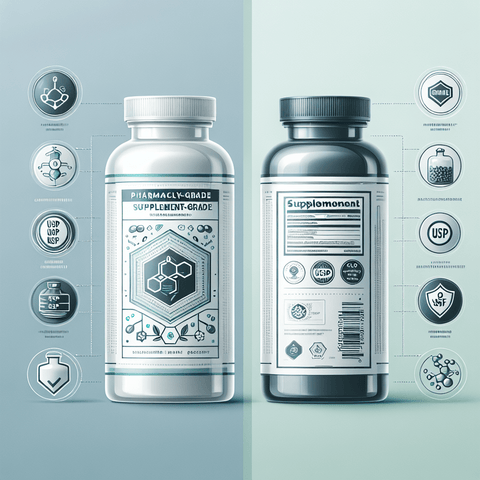
Pharmacy-grade vitamins are usually understood as supplements made with a strong emphasis on purity, potency and verified sourcing. The term is not a legal drug classification, and it does not mean a supplement works like a medicine. Instead, it points to quality expectations such as pharmaceutical-grade ingredients, GMP-compliant manufacturing, contaminant screening and batch documentation. For readers comparing supplement options, these details can make the difference between a vague label and a product story that can be checked.
This tag page is a broad starting point for that topic. It explains what pharmacy-grade quality typically involves, why testing and transparency matter, how pharmacy-grade and standard supplements may differ, and which nutrient or supplement categories are worth exploring next. More specific questions, such as individual dosage, condition-specific use or product-by-product comparisons, are better suited to dedicated articles linked from this hub.
What Pharmacy-Grade Vitamins Typically Means
There is no single universal definition of pharmacy-grade vitamins that applies identically across every market. In practice, the phrase usually describes a quality standard rather than a therapeutic category. It suggests that a manufacturer has taken extra steps to verify ingredients, control production and document testing. These steps are intended to support consistency and transparency, not to imply that a supplement can replace medical treatment.
Key quality signals often associated with pharmacy-grade positioning include:
- Pharmaceutical-grade or carefully vetted raw materials
- GMP-compliant manufacturing environments and processes
- Third-party or independent laboratory testing
- Contaminant screening, including heavy metals and microbial checks where applicable
- Certificates of Analysis (COAs) or similar batch documentation
- Allergen controls and traceability from raw material to finished goods
These signals do not guarantee a specific health outcome. They help answer a different question: whether the product has been made and documented in a way that supports confidence in its identity, potency and purity.
Why Testing, Potency and Bioavailability Are Central Topics
When readers search for pharmacy-grade supplements that actually work like medicine, they often mean they want products that are reliable, well documented and formulated with attention to how ingredients are absorbed and used by the body. That is a reasonable quality question, but it should not be confused with a medical efficacy claim. Supplements are not medicines, and no supplement should be presented as a treatment or cure.
Three concepts are especially useful for understanding quality at a broad level:
- Potency: whether the amount of an ingredient in the finished product matches what the label states.
- Purity: whether unwanted substances, contaminants or undeclared ingredients are controlled or absent within acceptable limits.
- Bioavailability: how a nutrient or compound is absorbed and made available to the body. This can vary by form, formulation and individual factors.
These topics are important because they shape how supplement quality is discussed in a clinical or pharmacist-reviewed context. They also explain why some labels provide more detail than others, and why third-party testing and clear formulation information can be useful when comparing products.
Pharmacy-Grade vs. Standard Supplements: A High-Level Comparison
Not every supplement marketed as high quality follows the same standards. A broad comparison can help readers understand what may differ between pharmacy-grade positioning and ordinary supplement ranges. The table below is a general guide, not a guarantee that every product in either category will match every point.
- Sourcing: pharmacy-grade positioning often involves stricter supplier vetting and documented raw material identity.
- Manufacturing: GMP-compliant production and controlled processes are commonly emphasised.
- Testing: independent laboratory testing and contaminant screening may be more clearly documented.
- Transparency: COAs and batch-level documentation may be available for review.
- Label clarity: ingredient forms, allergen controls and storage directions may be presented in more detail.
- Support: pharmacist-backed guidance may be available to help clarify formulation choices and general usage questions.
Standard supplements can still be appropriate for many people, and quality varies across the entire market. The useful question is not simply which category sounds better, but which product provides enough transparency for an informed decision.
Major Nutrient and Supplement Categories to Explore
Pharmacy-grade quality can apply across many types of supplements. Understanding the broader categories helps readers navigate the topic without treating any single product as a universal solution. Common areas include:
- Fat-soluble vitamins such as vitamins A, D, E and K
- Water-soluble vitamins such as B-complex vitamins and vitamin C
- Minerals such as magnesium, calcium, iron, zinc, selenium and trace minerals
- Multivitamins and broad-spectrum formulas
- Omega-3 fatty acids, including DHA and EPA
- Probiotics and prebiotics
- Herbal and botanical supplements, such as turmeric, curcumin and ashwagandha
- Amino acids and sports supplements
- Antioxidant-focused formulas and superfoods
Each category has its own formulation considerations. For example, some nutrients are better understood in the context of dietary intake, while others are commonly discussed in relation to specific life stages or needs. A broad guide like this one can introduce those dimensions, but individual articles are better placed to explore them in depth.
You can explore related product categories such as natural supplements or mineral supplements to see how quality considerations apply across different nutrient groups.
How to Read Quality Signals When Comparing Products
Labels and product pages can contain a great deal of information. A practical approach is to focus on the details that support verification and informed comparison rather than relying on claims alone.
- Check the ingredient list and the exact form of each nutrient or compound.
- Look for clear potency information that matches the label.
- See whether third-party testing or Certificates of Analysis are mentioned.
- Review allergen statements and storage directions where relevant.
- Consider whether pharmacist-backed support or educational content is available to clarify questions.
- Remember that general information is not personalised medical advice, and individual needs can vary.
These steps do not replace professional guidance, but they can make product comparisons more structured. They also help readers identify which questions to ask a healthcare professional if they are considering a supplement for a specific concern.
Safety, Context and Responsible Supplement Use
Quality is only one part of the picture. Even well-made supplements can be unnecessary or inappropriate for some people. Dietary intake, existing health conditions, medications, pregnancy, breastfeeding and individual nutritional status can all influence whether a supplement is suitable. This page does not provide personalised medical advice and should not be used to self-diagnose or self-treat.
A responsible approach is to treat pharmacy-grade vitamins as one factor in a broader decision. Quality documentation, transparent labelling and pharmacist-backed guidance can support that decision, but they do not replace advice from a qualified healthcare professional. Where a specific health concern exists, individual guidance is more appropriate than a general supplement guide.
Exploring the Topic Further
This tag page is intended to provide a useful map of the pharmacy-grade vitamins topic. The articles associated with this tag can go deeper into individual nutrients, forms, comparisons and practical questions. If you want to explore broader supplement categories alongside this topic, you can also browse multivitamins and related guides to see how quality considerations apply across different product types.
For readers new to the topic, the key takeaway is that pharmacy-grade positioning is primarily about quality systems, testing and transparency. It is not a promise of medical effect. Understanding those distinctions helps make supplement comparisons more grounded and supports more informed conversations with healthcare professionals.