{"
Qu'est-ce qu'un mélange exclusif ?
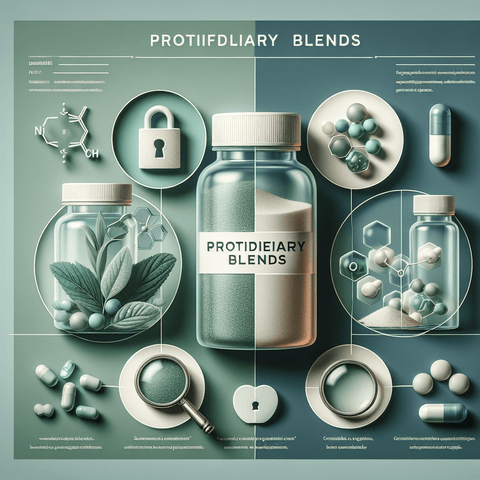
Un mélange exclusif (ou proprietary blend en anglais) est une combinaison d'ingrédients utilisée dans une formule de complément alimentaire, pour laquelle le fabricant indique sur l'étiquette la quantité totale du mélange, mais pas la quantité individuelle de chaque ingrédient qui le compose. Cette approche est courante dans les multivitamines, les compléments sportifs et les formules à base de plantes. Elle sert souvent à protéger la formulation spécifique d'une marque contre ses concurrents.
Pour les consommateurs, la principale conséquence est une transparence réduite : bien que la quantité totale du mélange soit indiquée, il n'est pas possible de déterminer exactement quelle quantité de chaque ingrédient—qu'il s'agisse d'un acide aminé, d'une plante ou d'un antioxydant—est incluse. Cela peut rendre plus difficile l'évaluation du fait qu'une formule contienne des quantités significatives des ingrédients mis en avant sur l'emballage.
À quoi prêter attention lors de l'évaluation d'un mélange exclusif
- Ordre d'inscription des ingrédients : sur de nombreuses étiquettes, les ingrédients sont généralement listés par ordre décroissant de poids, ce qui peut donner une indication approximative de ce que le mélange contient en plus grande proportion.
- Transparence de l'étiquetage : certaines marques choisissent de divulguer pleinement les quantités d'ingrédients plutôt que d'utiliser des mélanges, ce qui peut faciliter les comparaisons.
- Pertinence par rapport à vos besoins : l'adéquation d'une formule à votre situation dépend de votre alimentation globale, de vos objectifs nutritionnels et des conseils éventuels d'un professionnel de santé.
Les compléments alimentaires sont conçus pour compléter une alimentation équilibrée, et non pour la remplacer. Les besoins nutritionnels varient d'une personne à l'autre. Toute personne envisageant un complément contenant un mélange exclusif—qu'il s'agisse d'une multivitamine, d'un complément sportif ou d'un complément à base de plantes—peut souhaiter examiner attentivement l'étiquette et consulter un professionnel de santé en cas de doute. Des informations générales sur les produits sont également disponibles dans notre guide des multivitamines.
" : { "prompt": "Primary keyword:\nproprietary blend\n\nTarget locale:\nfr\n\nContent to translate:\nWhat Is a Proprietary Blend?
\nA proprietary blend is a combination of ingredients used in a supplement formula where the manufacturer lists the total amount of the blend on the label, but not the individual amount of each ingredient within it. This approach is common in multivitamins, sports supplements, and herbal formulas, and is often used to protect a brand's specific formulation from competitors.
\nFor consumers, the main implication is reduced transparency: while the total quantity of the blend is disclosed, it is not possible to determine exactly how much of each ingredient—such as an amino acid, herb, or antioxidant—is included. This can make it harder to evaluate whether a formula contains meaningful amounts of the ingredients highlighted on the packaging.
\n\nWhat to Consider When Evaluating a Proprietary Blend
\n- \n
- Ingredient list order: On many labels, ingredients are typically listed in descending order by weight, which can offer a rough indication of what the blend contains most of. \n
- Label transparency: Some brands choose to fully disclose ingredient amounts instead of using blends, which can make comparison easier. \n
- Relevance to your needs: Whether a formula suits you depends on your overall diet, nutritional goals, and any advice from a healthcare professional. \n
Supplements are intended to complement, not replace, a balanced diet. Nutritional needs vary from person to person, so anyone considering a supplement containing a proprietary blend—whether a multivitamin, sports supplement, or herbal supplement—may want to review the label carefully and consult a healthcare provider if in doubt. General product information can also be found in our multivitamins guide.
\n\nAvailable internal URLs for the target locale:\n[\"https://www.topvitamine.com/fr/collections/topvitamine-natural-supplements\",\"https://www.topvitamine.com/fr/collections/vitamin-a-benefits-sources-safety\",\"https://www.topvitamine.com/fr/collections/vitamin-d-benefits-sources-safety\",\"https://www.topvitamine.com/fr/collections/vitamin-b-benefits-sources-safety\",\"https://www.topvitamine.com/fr/collections/vitamin-c-benefits-immunity-antioxidant-energy\",\"https://www.topvitamine.com/fr/collections/vitamin-e-benefits-antioxidant-cell-health\",\"https://www.topvitamine.com/fr/collections/vitamin-k-benefits-bone-blood-health\",\"https://www.topvitamine.com/fr/collections/multivitamins-guide-ingredients-usage-safety\",\"https://www.topvitamine.com/fr/collections/magnesium-benefits-energy-muscle-bone-support\",\"https://www.topvitamine.com/fr/collections/calcium-benefits-bone-muscle-health-efsa\",\"https://www.topvitamine.com/fr/collections/mineral-supplements-guide-iron-zinc-selenium-iodine-copper-manganese-chromium\",\"https://www.topvitamine.com/fr/collections/superfoods-guide-efsa-approved-nutrient-claims\",\"https://www.topvitamine.com/fr/collections/herbal-supplements-traditional-guide-safety-sourcing\",\"https://www.topvitamine.com/fr/collections/curcumin-safe-regulated-health-uses\",\"https://www.topvitamine.com/fr/collections/turmeric-supplements\",\"https://www.topvitamine.com/fr/collections/ashwagandha-supplements\",\"https://www.topvitamine.com/fr/collections/amino-acids-supplements\",\"https://www.topvitamine.com/fr/collections/sports-supplements-guide\",\"https://www.topvitamine.com/fr/collections/probiotics-and-prebiotics-supplements\",\"https://www.topvitamine.com/fr/collections/dha-epa-omega-3-supplements\",\"https://www.topvitamine.com/fr/collections/healthy-origins-supplements\",\"https://www.topvitamine.com/fr/collections/dr-mercola-natural-health\",\"https://www.topvitamine.com/fr/collections/natures-plus-supplements\",\"https://www.topvitamine.com/fr/collections/allergy-research-group-supplements\",\"https://www.topvitamine.com/fr/collections/trace-minerals-supplements\",\"https://www.topvitamine.com/fr/collections/health-factory-supplements\",\"https://www.topvitamine.com/fr/collections/expiry-deals-40-discount\",\"https://www.topvitamine.com/fr/collections/expiry-deals-60-discount\",\"https://www.topvitamine.com/fr/collections/ati-oxidants\",\"https://www.topvitamine.com/fr/collections/antioxidants-help-protect-your-body-by-neutralizing-free-radicals\",\"https://www.topvitamine.com/fr/collections/fosfolipiden\"]\n\n---\n\n## TASK\n\nTranslate the complete content into:\n\nfr\n\nThe translated content will be published on Topvitamine.com.\n\nProduce a fluent, natural, publication-quality translation rather than a literal word-for-word translation.\n\nPreserve:\n\n* Meaning\n* Scientific accuracy\n* Nutritional context\n* Structure\n* Tone\n* Important nuances\n* Health and supplement claims\n* Existing useful information\n\nThe translated article should read as though it was originally written by a native speaker of the target language.\n\n---\n\n## PRIMARY KEYWORD & SEO\n\nSource primary keyword:\n\nproprietary blend\n\nDetermine the most natural and commonly searched equivalent of this primary keyword in the target language.\n\nUse that translated keyword as the PRIMARY SEO KEYWORD for the translated article.\n\nRequirements:\n\n* Use the translated primary keyword naturally near the beginning\n* Use it naturally in relevant headings where appropriate\n* Do NOT mechanically translate the keyword if native searchers would normally use a different term\n* Prefer terminology actually used by native speakers\n* Preserve the original search intent\n* Use natural semantic variations and closely related terms\n* Avoid keyword stuffing\n* Do not repeatedly force the exact keyword\n* Maintain readability above exact-match repetition\n\nFor supplement, vitamin, mineral, ingredient, health, and nutrition terminology, use the terminology most commonly used by consumers in the target market.\n\nDo NOT leave the primary keyword untranslated unless it is normally used unchanged in the target language.\n\n---\n\n## TRANSLATION QUALITY\n\nTranslate for meaning, not sentence-by-sentence literal equivalence.\n\nYou may naturally adjust:\n\n* Sentence structure\n* Word order\n* Expressions\n* Transitions\n* Headings\n* Terminology\n\nwhen this improves fluency in the target language.\n\nDo NOT:\n\n* Summarize the content\n* Shorten important sections\n* Add new claims\n* Add unsupported facts\n* Change the meaning\n* Remove relevant information\n* Introduce stronger medical or health claims than appear in the source\n\nMaintain approximately the same level of detail as the original.\n\n---\n\n## LOCALIZATION\n\nLocalize terminology naturally for:\n\nfr\n\nWhere appropriate:\n\n* Use locally familiar nutritional terminology\n* Use natural names for vitamins, minerals, herbs, ingredients, and supplement forms\n* Use natural health terminology\n* Use locally appropriate spelling and grammar\n* Use metric units\n* Preserve numerical values unless localization requires formatting changes\n* Adapt decimal and number formatting when appropriate for the target language\n\nDo not unnecessarily localize scientific names, internationally recognized ingredient names, abbreviations, or units.\n\n---\n\n## HEALTH & SUPPLEMENT CONTENT\n\nMaintain a scientifically responsible and evidence-aware tone.\n\nDo not strengthen claims during translation.\n\nIn particular:\n\n* Do not claim that supplements cure, treat, reverse, or prevent disease unless explicitly supported by the source\n* Do not diagnose nutritional deficiencies from symptoms\n* Do not imply that everyone needs supplementation\n* Preserve qualifiers such as \"may\", \"can\", \"has been associated with\", and similar uncertainty language\n* Preserve relevant safety information\n* Preserve references to individual variability\n* Keep nutritional support distinct from medical treatment\n\n---\n\n## HTML & FORMAT\n\nPreserve the existing HTML structure.\n\nAllowed HTML includes:\n\n*\n* \n*
\n*