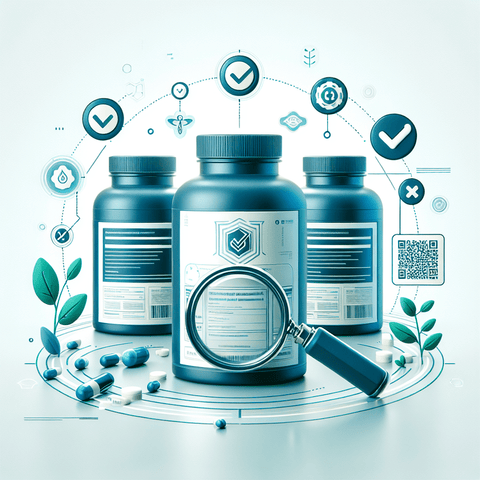
Une source vérifiée de compléments alimentaires est une marque ou un revendeur dont les produits sont fabriqués selon des normes documentées, soumis à des contrôles indépendants et étiquetés de manière transparente. La vérification repose sur des preuves traçables — certifications reconnues, informations de lot et certificats d’analyse — plutôt que sur des arguments marketing. Les compléments alimentaires relèvent généralement du droit alimentaire et ne sont pas soumis à la même autorisation préalable que les médicaments : ces vérifications constituent donc un repère important, sans garantir l’efficacité ni l’adéquation d’un produit à chacun.
Qu'est-ce qu'une source vérifiée de compléments alimentaires ? Définition et piliers de la vérification
Une source vérifiée désigne une marque ou un revendeur capable de documenter la fabrication, les contrôles et l’étiquetage de ses produits. Trois éléments sont particulièrement utiles à examiner : le respect des bonnes pratiques de fabrication actuelles (cGMP, ou BPF actuelles), des analyses du produit fini réalisées par un laboratoire indépendant et une étiquette indiquant clairement les ingrédients et leurs quantités.
Les mentions « premium » ou « qualité pharmaceutique » ne constituent pas, à elles seules, des preuves de qualité définies par une norme légale. À l’inverse, une certification vérifiable, un rapport d’analyse associé à un lot ou des informations sur un site de fabrication audité sont des éléments traçables. Une règle pratique consiste à considérer toute allégation de qualité sans document justificatif comme un argument publicitaire.
Les termes employés ne recouvrent pas tous la même chose : les tests par des tiers sont réalisés par un laboratoire indépendant du fabricant ; les cGMP encadrent notamment l’hygiène, la documentation, la traçabilité et les contrôles de fabrication ; un certificat d’analyse (CoA) présente les résultats d’analyses d’un lot précis. Les analyses peuvent porter sur l’identité, la teneur et la pureté, ainsi que sur certains contaminants ou substances non déclarées, selon les tests effectués.
- Tests indépendants : analyses du produit fini dont le périmètre dépend du protocole du laboratoire.
- cGMP : bonnes pratiques de fabrication actuelles couvrant notamment l’hygiène, la traçabilité, la documentation des lots et le contrôle qualité.
- Certificat d’analyse (CoA) : document présentant les résultats d’analyse d’un lot donné.
- Programmes et contrôles à rechercher selon le produit : USP Verified, NSF, Informed Sport et tests IFOS pour certaines huiles de poisson.
Les certifications de compléments alimentaires : USP, NSF, Informed Sport et autres programmes
Les certifications de compléments alimentaires ne couvrent pas toutes les mêmes critères. Leur portée dépend du programme et du produit concerné : il est donc utile de vérifier ce qui a été contrôlé, si l’évaluation concerne le produit fini et si le produit figure dans la base de données du programme.
Le sceau USP Verified indique qu’un produit a été évalué selon le programme USP, notamment au regard de son identité, de sa teneur et de certains contaminants. NSF propose des certifications de qualité et de sécurité, ainsi que NSF Certified for Sport, destiné aux produits utilisés dans le contexte sportif. Informed Sport et Informed Choice sont des programmes axés sur le dépistage de substances interdites dans les produits concernés. IFOS est un programme de tests indépendants consacré aux huiles de poisson, notamment pour leur fraîcheur et leur teneur.
Une évaluation portant sur des lots de produits finis en circulation peut fournir des informations plus pertinentes pour le produit acheté qu’un contrôle ponctuel réalisé dans le passé. Les certifications et leurs critères évoluent : recherchez l’allégation dans la base de données officielle du programme et vérifiez qu’elle correspond bien au produit et, lorsque l’information est disponible, au lot concerné. Le respect des règles de sécurité alimentaire applicables constitue un socle réglementaire, et non en soi une certification indépendante.
- USP Verified
- NSF et NSF Certified for Sport
- Informed Sport et Informed Choice
- IFOS pour les huiles de poisson
- Certificat d’analyse associé à un lot précis
Comment vérifier qu'un complément alimentaire est testé par un tiers : guide pas à pas
Avant l’achat, quelques vérifications simples permettent de distinguer une information contrôlable d’une promesse générale. Elles ne garantissent pas qu’un complément soit nécessaire ou adapté, mais aident à mieux évaluer la transparence de la source.
- Recherchez le nom de la certification sur l’étiquette, puis vérifiez l’allégation dans la base de données officielle du programme.
- Demandez un certificat d’analyse récent correspondant au lot que vous envisagez d’acheter ; vérifiez que le numéro de lot ou les informations de correspondance y figurent.
- Contrôlez la présence d’un numéro de lot, d’une date de péremption et du nom et de l’adresse du fabricant.
- Privilégiez l’achat auprès de la marque ou d’un revendeur agréé, dont l’identité et les coordonnées sont vérifiables.
- Lisez la liste complète des ingrédients et les quantités par portion ; une mention de « mélange propriétaire » peut empêcher de connaître la quantité de chaque ingrédient.
Une marque qui ne peut fournir aucune information sur ses contrôles ou sur la traçabilité mérite une vérification supplémentaire. Un certificat d’analyse n’est utile que si son contenu, sa date, le produit analysé et le lot sont clairement identifiables.
Signaux d'alerte : les signes d'une source de compléments alimentaires non vérifiée
Un seul indice ne permet pas toujours de conclure qu’un produit est contrefait ou de mauvaise qualité. Plusieurs éléments réunis — notamment l’absence de traçabilité et le refus de fournir des documents — doivent toutefois inciter à la prudence.
- Absence de numéro de lot ou de date de péremption.
- Mélange propriétaire qui ne précise pas les quantités individuelles.
- Allégations affirmant qu’un produit guérit, inverse ou traite une maladie.
- Fabricant impossible à identifier, sans adresse ni coordonnées de contact vérifiables.
- Prix nettement inférieur à ceux proposés par les revendeurs agréés, sans explication claire.
- Refus de communiquer un certificat d’analyse ou des informations sur les tests indépendants.
Ces signaux peuvent se rencontrer sur des places de marché tierces, auprès de vendeurs sur les réseaux sociaux ou dans des circuits d’importation difficiles à tracer. Une offre à prix irréaliste ne prouve pas à elle seule qu’un produit est frauduleux, mais il est préférable de vérifier l’identité du vendeur et la chaîne d’approvisionnement avant l’achat.
Les catégories de produits où la qualité de la source compte le plus
Les critères à examiner varient selon la nature du complément. Pour certaines catégories, la fraîcheur, la viabilité ou l’identification des ingrédients rendent les informations de lot et les analyses indépendantes particulièrement utiles.
- Huiles de poisson : elles peuvent s’oxyder. Examinez la teneur déclarée en EPA et DHA ainsi que les informations de fraîcheur ; des tests tels qu’IFOS peuvent apporter des éléments de contrôle.
- Probiotiques : vérifiez l’identité des souches et la manière dont la viabilité est exprimée. Le nombre indiqué à la fabrication ne renseigne pas nécessairement sur la quantité restante à la fin de la durée de conservation.
- Multivitamines : comparez les formes de nutriments, les quantités par portion et la transparence de la formule ; un mélange propriétaire peut masquer les doses.
- Extraits de plantes : l’identification de l’espèce, la standardisation et le dépistage de contaminants sont des critères à examiner. Un certificat d’analyse propre au lot peut être particulièrement informatif.
Les probiotiques et les prébiotiques sont associés à des questions de microbiome intestinal, mais leur présence dans un produit ne permet pas de déduire un effet individuel. Les résultats dépendent notamment des souches et des caractéristiques du produit ; les compléments ne remplacent pas une évaluation médicale.
Comment choisir le bon complément auprès d'une source vérifiée : forme, dose et pureté
La vérification de la qualité est un premier filtre, pas une garantie qu’un produit répondra à un besoin personnel. Une fois la traçabilité et les contrôles examinés, comparez la forme du nutriment, la quantité par portion, la composition et le format du produit. La biodisponibilité peut varier selon les formes, mais aucune forme n’est universellement la meilleure : par exemple, l’oxyde, le citrate et le glycinate de magnésium, ou les vitamines D2 et D3, ne sont pas interchangeables dans tous les contextes.
Vérifiez la quantité par portion plutôt que de vous fier au nombre de gélules ou au poids total du flacon. Pour les vitamines et minéraux, l’étiquette peut également indiquer un pourcentage des valeurs nutritionnelles de référence (VNR). Une quantité plus élevée n’est pas automatiquement préférable ; les apports adaptés dépendent notamment de l’alimentation et de la situation individuelle.
Une formule combinée peut être pratique, mais elle fixe les proportions des ingrédients. Si vous comparez plusieurs produits ou envisagez une association, examinez les quantités de chaque nutriment — notamment dans les formules contenant, par exemple, du zinc et du cuivre ou du calcium et du fer — et demandez conseil à un professionnel de santé en cas de traitement, de grossesse ou de question sur vos apports.
- Forme du nutriment et biodisponibilité, sans supposer qu’une forme convient à tous.
- Quantité par portion et pourcentage de VNR, le cas échéant.
- Formule combinée ou ingrédient isolé, avec des doses clairement indiquées.
- Certifications pertinentes et certificat d’analyse propre au lot.
- Allergènes, excipients, ingrédients ajoutés et format : gélules, comprimés, poudre ou liquide.
Un complément ne remplace pas une alimentation variée. En cas de prise de médicaments, de grossesse, d’affection rénale ou hépatique, ou de doute concernant un manque nutritionnel, demandez conseil à un professionnel de santé qualifié.
Comment lire une étiquette de complément alimentaire comme un inspecteur qualité
Pour lire une étiquette de complément alimentaire, commencez par la taille de la portion : les quantités indiquées s’y rapportent, et non nécessairement à une gélule ou à l’ensemble du flacon. Comparez ensuite la quantité du nutriment avec le pourcentage de VNR, lorsqu’il est indiqué.
Distinguez le poids du composé de la quantité du nutriment qu’il apporte. Ainsi, « 500 mg de carbonate de calcium » ne signifie pas nécessairement que le produit fournit 500 mg de calcium élémentaire. L’étiquette doit permettre de comprendre clairement la quantité déclarée pour la portion.
- Taille de la portion et nombre d’unités correspondant.
- Quantité de nutriment, à distinguer du poids total du composé.
- Pourcentage de VNR, lorsqu’il est applicable.
- Numéro de lot et date de péremption.
- Nom et coordonnées du fabricant, ainsi que les conditions de conservation.
- Liste complète des ingrédients et des autres ingrédients.
Pour les probiotiques, vérifiez si le nombre de micro-organismes est garanti jusqu’à la fin de la durée de conservation ou seulement à la fabrication. Pour les extraits de plantes, recherchez une quantité clairement indiquée et, le cas échéant, la standardisation de l’extrait.
Foire aux questions
Que signifie « testé par un tiers » ? Un laboratoire indépendant analyse un produit selon un protocole donné. Les tests peuvent vérifier l’identité, la teneur et certains aspects de la pureté ; leur portée dépend des analyses réalisées.
Comment savoir si un complément est vérifié USP ? Recherchez le sceau USP Verified, puis vérifiez le produit dans la base de données officielle du programme. Le sceau ne signifie pas que le complément convient à chaque personne.
Qu’est-ce qu’un certificat d’analyse (CoA) ? C’est un document de laboratoire qui présente les résultats d’analyse d’un lot précis. Demandez à la marque un document récent et vérifiez qu’il correspond au produit et au lot concernés.
Les compléments alimentaires sont-ils réglementés comme des médicaments ? Non : ils relèvent généralement du droit alimentaire et ne suivent pas la même procédure d’autorisation préalable que les médicaments. Les règles applicables varient selon les marchés, ce qui renforce l’intérêt de vérifier la traçabilité et les contrôles annoncés.
Est-il sûr d’acheter sur une place de marché en ligne ? Le niveau de risque dépend du vendeur et de la traçabilité. Soyez particulièrement prudent avec les vendeurs tiers anonymes ; privilégiez la marque ou un revendeur agréé et vérifiez le numéro de lot et les coordonnées du fabricant.
Quelles certifications rechercher ? Selon le produit et le besoin, vous pouvez examiner USP Verified, NSF, Informed Sport ou Informed Choice. Pour les huiles de poisson, IFOS peut apporter des informations de test. Vérifiez toujours la portée du programme et la présence du produit dans sa base de données.
Que garantit réellement la mention « certifié cGMP » ? Elle renvoie à des bonnes pratiques de fabrication et à des contrôles du site ou du processus de fabrication. Elle ne prouve pas nécessairement, à elle seule, que chaque lot fini a fait l’objet d’analyses indépendantes confirmant toutes les informations de l’étiquette.
Les compléments peuvent-ils contenir des contaminants ? Des contaminations ou des écarts de composition peuvent survenir. Les analyses indépendantes, les certificats propres à un lot et une chaîne d’approvisionnement traçable aident à mieux évaluer les contrôles effectués, sans garantir un risque nul.
« Qualité pharmaceutique » a-t-elle un sens juridique précis ? Cette formule ne correspond pas, à elle seule, à une norme légale définie pour les compléments alimentaires. Demandez quelles preuves concrètes la marque associe à cette allégation.
Comment vérifier qu’une marque est légitime ? Recherchez des coordonnées et un fabricant vérifiables, des informations de lot, des éléments documentés sur la fabrication et des certificats d’analyse ou certifications contrôlables. Vérifiez également que le vendeur est autorisé par la marque, si celle-ci fournit cette information.
Faut-il se fier aux recommandations d’influenceurs ? Elles peuvent attirer l’attention sur un produit, mais doivent être considérées comme des recommandations ou de la publicité, et non comme une preuve de qualité ou d’efficacité. Vérifiez les documents et les allégations par vous-même.
Existe-t-il des compléments dont les effets sont médicalement prouvés ? Les preuves concernent des nutriments, des doses et des situations précises ; elles ne signifient pas qu’un complément est nécessaire ou bénéfique pour tout le monde. Les allégations de guérison ou de traitement d’une maladie ne sont pas un signe de qualité.
Acheter auprès d’une source vérifiée garantit-il que le complément me conviendra ? Non. La vérification porte sur des aspects de qualité, de composition ou de fabrication ; elle ne détermine ni vos besoins personnels ni l’adéquation du produit à votre situation.