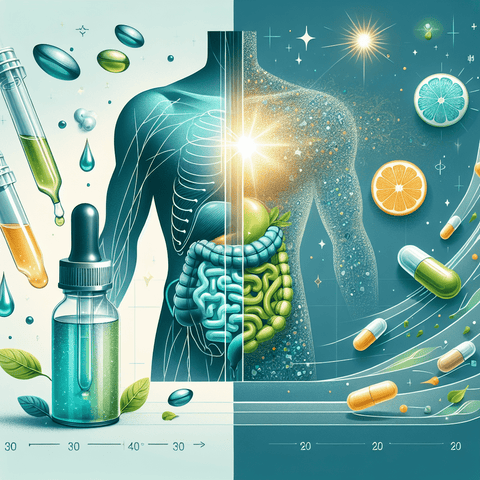
Liquid vs Capsule Supplements: Which Absorbs Better?
If you're comparing liquid vs capsule supplements, a common question is which form absorbs faster and works more effectively. For many nutrients, liquid supplements have a potential absorption advantage because they are already dissolved and ready for intestinal absorption. This can lead to faster onset, which is why liquid forms are often preferred for fast-acting vitamins. However, capsules are convenient, portable, and can be formulated for controlled release. The right choice depends on your health goals, lifestyle, and the specific supplement.
How Absorption Speed Differs Between Liquids and Capsules
Absorption speed is one of the biggest differences between liquid and capsule supplements. Here's how they compare:
- Liquid supplements: Already in a dissolved state, so they can begin absorption in the stomach and small intestine almost immediately after ingestion. This may lead to faster nutrient delivery and quicker effects.
- Capsule supplements: Must first dissolve in the digestive tract, releasing the active ingredients before absorption can occur. This extra step can delay onset, but some capsules are designed to dissolve quickly or use technologies like liposomal delivery to enhance absorption.
While liquids generally have an edge in speed, the actual absorption also depends on factors like the nutrient form, dose, pH, and individual digestive health.
Bioavailability of Supplements: Why Form Matters
Bioavailability of supplements refers to the amount of a nutrient that your body can actually absorb and use. Both liquid and capsule forms can be highly bioavailable if formulated well. For instance, certain liquid formulas use buffered or mineral ascorbate forms (like sodium or magnesium ascorbate) that may be gentler on the stomach and enhance absorption. Similarly, liposomal capsules or liquids can improve nutrient delivery by protecting the nutrient through the digestive tract.
However, bioavailability is not solely determined by the form. Factors such as the specific nutrient, its chemical structure, whether you take it with food, and your digestive health all play significant roles. For example, fat-soluble vitamins (A, D, E, K) are better absorbed when taken with dietary fat, regardless of whether they are in liquid or capsule form.
Liquid vs Capsule Supplements: Pros and Cons
Liquid Supplements
- Advantages: Faster absorption, flexible dosing (easy to adjust for children or specific needs), often easier to swallow for those who have difficulty with pills, and may be gentler on sensitive stomachs when buffered.
- Considerations: Can be less portable, may have a shorter shelf life once opened, and some formulations may have an unpleasant taste.
Capsule Supplements
- Advantages: Convenient and portable, precise dosing, longer shelf life, and easy to take on the go. Many capsules can be opened and mixed with food or drink if needed.
- Considerations: Slower onset due to the need to dissolve, potential for gastrointestinal discomfort if the capsule doesn't break down properly, and less flexibility in dosing.
Which Form Works Faster: Liquids or Pills?
In general, liquid supplements work faster than capsules because they skip the breakdown step. This is especially relevant for sleep aids or other supplements where you want a quick effect. For example, a liquid sleep aid may kick in sooner than the same dose in a capsule. However, the exact onset time can vary based on the ingredient, formulation, and individual metabolism. If you're looking for fast-acting vitamins or supplements, liquid forms are often the better choice. For daily maintenance, capsules are perfectly effective and may be more convenient.
Making Your Choice: Practical Guidance
When deciding between liquid and capsule supplements, consider your priorities:
- Choose liquids if: You want potentially faster absorption, need flexible dosing, have difficulty swallowing pills, or have a sensitive stomach (especially with buffered formulas).
- Choose capsules if: You value convenience and portability, prefer precise dosing, or are managing a busy lifestyle where carrying a bottle isn't practical.
Both forms can effectively support your nutritional needs if they come from reputable brands that use high-quality ingredients. Always read labels carefully and follow the recommended dosage.
Frequently Asked Questions
Do liquid supplements absorb faster than capsules?
Yes, liquid supplements generally absorb faster because they are already dissolved, allowing for immediate absorption in the digestive tract. Capsules must first break down, which can delay onset.
Are liquid capsules faster acting than tablets?
Liquid capsules, which contain a liquid or oil inside a gelatin shell, may be faster acting than traditional tablets because the liquid contents can be absorbed more quickly once the capsule dissolves. However, the difference depends on the specific formulation.
How long does it take for liquid supplements to work?
Onset can vary by nutrient and formulation, but liquid supplements typically begin absorbing within minutes of ingestion. The full effect may take longer, depending on the nutrient and your body.
Which is better for absorption: liquids or powders?
Both liquids and powders can offer high absorption when mixed with water, as they bypass the breakdown step. Powders need to be dissolved in liquid before consumption, while liquids are ready to use. The choice often comes down to convenience and taste.
Final Thoughts
Both liquid and capsule supplements have their place in a wellness routine. If fast absorption and flexible dosing are your priorities, liquid supplements are a strong option. If convenience and portability matter more, capsules are a reliable choice. Consider your specific health needs, lifestyle, and any sensitivities you have. For personalized advice, especially if you have underlying health conditions or take medications, consult a qualified healthcare professional.